Monday, May 21, 2012

New Addition: Memorable European Confrontations, Part one-1985 Juventus vs. Bordeaux

A new feature that I will be doing is about match summaries of home and away legs of European Cups confrontations.

The first one I will be doing is on the semi finals of the 1985 edition of Champions Cup between Italy’s Juventus and France’s Girondins de Bordeaux.

French Champions Bordeaux had advanced to the semifinals by eliminating Spain’s Athletic Bilbao, Romania’s Dinamo Bucharest and USSR’s Dnipro Dnipropetrovsk in the Quarterfinals after penalty kick shoot-out.
This was an experienced squad managed by future 1998 World Cup winning manager Aimé Jacquet and boasted many French internationals including Captain Alain Giresse and Jean Tigana.
Domestically they were running away with the League title for the second consecutive season.

Photo From: Onze, Hors Serie 22, 1985
(Captains Gaetano Scirea and Alain Giresse, April 10, 1985, Juventus 3-Bordeaux 0)


Italian Champions Juventus had an easier passage to the semifinals by eliminating Finland’s Ilves Tampere, Switzerland’s Grasshoppers Zurich and Czechoslovakia’s Sparta Prague.
This star studded squad, managed by Giovanni Trappatoni, contained four World Cup champions from 1982 (Antonio Cabrini, Gaetano Scirea, Marco Tardelli, Paolo Rossi), a European Champion and France Captain Michel Platini and Poland star Zbigniew Boniek.
With Juventus completely off the pace in the League, the Champions Cup was its only chance of any silverware and all energy was spent in its quest to erase the memory of the loss of 1983 to SV Hamburg.

Photo From: Onze, Hors Serie 22, 1985
(Michel Platini and Alain Giresse, April 10, 1985, Juventus 3-Bordeaux 0)


The first leg took place in Turin’s Stadio Communale on April 10, 1985.
Juventus were missing usual Stopper Sergio Brio; Nicola Caricola replaced him in the lineup.
Luciano Bodini had displaced Stefano Tacconi as starting goalkeeper, though Tacconi would be back by the time of the final.
Juventus completely overpowered Bordeaux and won 3-0 to hold a seemingly insurmountable lead.
Platini assisted the first two goals. He first sent a long to cross for Boniek to sneak through and score in the first half.
He then supplied the cross for Massimo Briaschi to stab home.

Photo From: Onze, Hors Serie 22, 1985
(Briaschi scoring Juventus’ second goal, April 10, 1985, Juventus 3-Bordeaux 0)

Although there were some suggestions that Briaschi may have pushed Gernot Rohr before scoring.
Platini himself scored the third with a first time volley from the edge of 18-yard line from a cross by Boniek.
Bordeaux had looked so much out of their depth that no one gave them a chance of overcoming the deficit.
René Girard was replaced shortly after the first goal through injury.


April 10, 1985
Juventus Football Club-Torino (Italy) 3- Girondins de Bordeaux Football Club (France) 0
Champions Cup- Semi Finals, First Leg   
Venue: Turin-Stadio Communale 
Attendance: 70,000
Referee: Bruno Galler (Switzerland)
Goalscorers: (Juventus): Zbigniew Boniek 28, Massimo Briaschi 67, Michel Platini 70
 (Bordeaux): None
Lineups:
Juventus:
1-Luciano Bodini, 2-Luciano Favero, 3-Antonio Cabrini, 6-Gaetano Scirea, 5-Nicola Caricola, 8-Marco Tardelli, 4-Massimo Bonini, 10-Michel Platini (France), 11-Zbigniew Boniek (Poland), 9-Paolo Rossi, 7-Massimo Briaschi

Coach: Giovanni Trappatoni

Other Subs:
12-Stefano Tacconi, 13-Stefano Pioli, 14-Cesare Prandelli, 15-Berniamino Vignola, 16-Giovanni Koetting

Team Captain: Gaetano Scirea
Official Kit Supplier/Designer: Kappa
Shirt Sponsor: Ariston
Uniform Colors: White/Black vertical striped Shirts, White Shorts, White Socks

Bordeaux:
1-Dominique Dropsy, 2-Gernot Rohr (West German, naturalized French), 5-Patrick Battiston, 4-Leonard Specht, 3-Thierry Tusseau, 6-René Girard (12-Jean-Christophe Thouvenel 31st), 14-Jean Tigana, 10-Alain Giresse, 8-Fernando Chalana (Portugal), 9-Bernard Lacombe, 11-Dieter Muller (West Germany)

Coach: Aimé Jacquet

Other Subs:
13-Michel Audrain
15-Antoine Martinez
16-Christian Delachet

Team Captain: Alain Giresse

Official Kit Supplier/Designer: Adidas

Shirt Sponsor: Malardeau
Uniform Colors: Navy Blue Shirts, White Shorts , Navy Blue Socks


For the return leg at Bordeaux on April 24, 1985, Juventus’ game plan was naturally defensive.
Their aim was to avoid giving up goals and holding the lead.
Bordeaux made adjustments to their lineup from the first leg. Thouvenel took his usual place at right back, Rohr was pushed in the midfield to mark Platini and Chalana was benched.
Tusseau was also pushed from defense into the midfield.
Chalana missed most of the season through injury and Jacquet did not want to gamble on him for such an important match.
Players were assigned to man-to-man marking.

Photo From: Onze, May, 1985
(Captains Alain Giresse  and Gaetano Scirea , April 24, 1985, Bordeaux  2-Juventus 0)

Bordeaux came with everything they had and attacked from the onset.
Midway through the first half, West German striker Dieter Muller scored by spinning and taking a low shot after some nice work by Lacombe.

Photo From: Onze, May, 1985
(Diter Muller scoring Bordeaux’s first goal , April 24, 1985, Bordeaux  2-Juventus 0)

This galvanized Bordeaux to continue attacking, but despite dominating for the rest of the match, they could not find a way until about 10 minutes left when Patrick Battiston’s long-range shot ricochet off the post and in.
There was less than 10 minutes left and Bordeaux sensed that at least tying the score was still a possibility and continued attacking.
Tigana came close in the closing minutes, but Juventus held on and advanced 3-2 on aggregate.

Photo From: Le Livre d’or du Football, 1985
(Jean Tigana surrounded by Bonini, Scirea and Favero , April 24, 1985, Bordeaux  2-Juventus 0)

Bordeaux were eliminated but exited honorably by defeating a team of Juventus’ pedigree.
Juventus advanced to the final to meet Liverpool.
However, that match will be remembered due to the Heysel Stadium Disaster that took 39 lives mostly Juve fans.

April 24, 1985
Girondins de Bordeaux Football Club (France) 2-Juventus Football Club-Torino (Italy) 0
Champions Cup- Semi Finals, Second Leg
Venue: Bordeaux-Parc Municipal    
Attendance: 43,000
Referee: Augusto Lamo Castillo (Spain)
Goalscorers: (Bordeaux): Dieter Muller 42, Patrick Battiston 79
 (Juventus): None
Lineups:
Bordeaux:
1-Dominique Dropsy, 2-Jean-Christophe Thouvenel, 5-Patrick Battiston, 4-Leonard Specht, 3-Thierry Tusseau, 6-René Girard, 14-Jean Tigana, 10-Alain Giresse, 7-Gernot Rohr (West German, naturalized French) (12-Fernando Chalana (Portugal) 51st), 9-Bernard Lacombe, 11-Dieter Muller (West Germany)

Coach: Aimé Jacquet
Booked: Girard 28, Rohr 37, Thouvenel 64, Lacombe 83

Other Subs:
13-Antoine Martinez
15-Michel Audrain
16-Christian Delachet

Team Captain: Alain Giresse

Official Kit Supplier/Designer: Adidas

Shirt Sponsor: Malardeau
Uniform Colors: Navy Blue Shirts, White Shorts , Navy Blue Socks


Juventus:
1-Luciano Bodini, 2-Luciano Favero, 6-Gaetano Scirea, 5-Nicola Caricola, 3-Antonio Cabrini, 8-Marco Tardelli, 4-Massimo Bonini, 10-Michel Platini (France), 11-Zbigniew Boniek (Poland), 9-Paolo Rossi (14-Cesare Prandelli 64th), , 7-Massimo Briaschi (13-Stefano Pioli 87th)

Coach: Giovanni Trappatoni
Booked: Briaschi 31, Bonini 36, Favero 83

Team Captain: Gaetano Scirea
Official Kit Supplier/Designer: Kappa
Shirt Sponsor: Ariston
Uniform Colors: White/Black vertical striped Shirts, White Shorts, White Socks


Trivia and Facts-Part 17

1-After Eric Cantona’s departure from French Football in early 1992, he tried out for Sheffield Wednesday by playing in an indoor tournament.
Before giving him a contract, Sheffield manager Trevor Francis wanted to see him play on grass, he therefore wanted to extend the trial period to an extra week.
Cantona refused and left and signed for Leeds United and won the League title at the end of the season.

Photo from:  Goal, November 1995
(Eric Cantona in a Sheffield Wednesday jersey)


2- During much of the 1960s and 70s, Italy’s stars were AC Milan’s Gianni Rivera and Inter’s Sandro Mazzola.
For the 1970 World Cup, they were both vying for the same position in the team.
So good were they both, that it was unthinkable to eliminate one at the expense of the other. While at the same time the other positions could not be disrupted.
Italy Manager Ferrucio Valcareggi came up with a compromise of sorts. Each player would play one half. Mazzola would play the first half and Rivera would replace him for the second half.
This policy came to be known as ‘La Staffetta’ (The Relay).

Photo from: 100 Anni del Campionato del Calcio
(Gianni Rivera and Sandro Mazzola)


3- In early 1992, Diego Maradona was still serving his ban for failing a drugs test the previous season with his club Napoli.
He played a charity match to raise funds for the family of recently deceased footballer, Juan Gilberto Funes (ex-River Plate).
Some at FIFA suggested that he was violating his ban by playing.
There was such an outcry from Argentines that FIFA had to drop the matter and stated there would be no violation, since it was only a charity match.

Photo from : World Soccer, April 1993
(Diego Maradona pursued by Branco, February 18, 1993, Argentina 1-Brazil 1)


4- Before the match between Poland and Brazil during the 1978 World Cup (June 21st) , Poland goalkeeper Jan Tomaszewski took medicine for his cold and running nose. It turned out that the medication might have contained banned substances. He was dropped in favor of Zygmunt Kukla.

Photo from:  World Cup 78, Author Phil Soar
(Poland goalkeeper JanTomaszewski, June 10, 1978, World Cup, Poland 3-Mexico 1)


5- In the late 1970s Italy’s lineup mostly consisted of players from the two most in-form teams of the time, Juventus and Torino.
Prior to Italy’s match vs. Belgium on January 26, 1977 (2-1 Italy win), Italian manager Enzo Bearzot was under presuure by authorities to include AS Roma or Lazio players in his lineup to attract the Roman crowd.
Undeterred, Bearzot replied “I’m paid to look after the Football team, not the bank account”


Photo From: Azzurri, Storia della Nazionale di calcio tre volte campioni del Mondo, 1910-1983
(Paolino Pulici of Torino in action vs. Belgium, January 26, 1977, Italy 2-Belgium 1)

Sunday, May 20, 2012

May 2, 1985 Bulgaria 2-France 0

May 2, 1985
Bulgaria 2-France 0
World Cup Qualifying-Group 4     
Venue: Sofiya- Vassil Levski Stadion       
Attendance: 70,000
Referee: Brian McGinlay (Scotland)
Goalscorers: (Bulgaria): Georgi Dimitrov 11, Nasko Sirakov 61   
 (France): None
Lineups:
Bulgaria:
1-Borislav Mikhailov (Druzestvo za Fizkultura i Sport Levski-Spartak - Sofia) [20 / 0]  
2-Plamen Nikolov (Druzestvo za Fizkultura i Sport Levski-Spartak - Sofia) [38 / 1]  
5-Georgi Dimitrov (CSKA(Centralnij Sport Klub Armija) Septemvri zname-Sofia) [53 / 6]  
3-Nikolai Arabov (Druzestvo za Fizkultura i Sport Sliven) [29 / 0]  
4-Petar Petrov (CSKA(Centralnij Sport Klub Armija) Septemvri zname-Sofia) [24 / 0]  
8-Nasko Sirakov (Druzestvo za Fizkultura i Sport Levski-Spartak - Sofia) [13 / 3]  
6-Radoslav Zdravkov (CSKA(Centralnij Sport Klub Armija) Septemvri zname-Sofia) [57 / 10]  
10-Anyo Sadkov (Druzestvo za Fizkultura i Sport Lokomotiv-Plovdiv) [35 / 3]  
9-Boicho Velichkov (Druzestvo za Fizkultura i Sport Lokomotiv-Sofia) [21 / 3]    (14-Andreï Jeliazkov (Druzestvo za Fizkultura i Sport Slavia Sofia) [46 / 14]  56)
7-Plamen Getov (Druzestvo za Fizkultura i Sport Spartak -Pleven) [7 / 1]   (15-Atanes Pashev (Armeysko Fizkulturno Druzhestvo Trakia Ploviv) [7 / 1] 75)
11-Stoicho Mladenov (CSKA(Centralnij Sport Klub Armija) Septemvri zname-Sofia) [50 / 15]  

Coach: Ivan Vutzov
Booked: Zdravkov 71-Jeliazkov 75

Team Captain: Georgi Dimitrov
Official Kit Supplier/Designer: Adidas
Uniform Colors: White Shirts, Green Shorts, White Socks


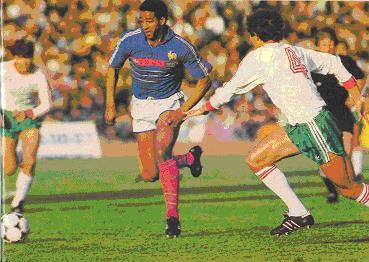
Photo from: Onze, Hors Serie 26, 1985


France:
1-Joel Bats (Association de la Jeunesse Auxerroise)  [17 / 0]  
2-William Ayache (Football Club de Nantes) [3 / 0]  
4-Leonard Specht (Girondins de Bordeaux Football Club) [18 / 1]  
5-Maxime Bossis (Football Club de Nantes) [64 / 1]  
3-Manuel Amoros (Association Sportive de Monaco) [27 / 0]  
7-Jose Toure (Football Club de Nantes) [6 / 1]  
14-Jean Tigana (Girondins de Bordeaux Football Club) [37 / 0]  
6-Luis Fernandez (Paris Saint-Germain Football Club) [22 / 2]     (8-Thierry Tusseau (Girondins de Bordeaux Football Club) [16 / 0]   69)
10-Michel Platini (Juventus Football Club-Torino / Italy) [58 / 37]  
9-Yannick Stopyra (Toulouse Football Club) [14 / 6]  
11-Bruno Bellone (Association Sportive de Monaco) [21 / 2]  

Coach: Henri Michel
Booked: Fernandez 13,Specht 41-Platini 85

Other Subs:
Albert Rust (Football Club de Sochaux-Montbéliard)
Jean-Francois Domergue (Toulouse Football Club)
Gérard Buscher  (Brest Armorique Football Club)
Daniel Bravo (Association Sportive de Monaco)

Team Captain: Michel Platini

Official Kit Supplier/Designer: Adidas

Uniform Colors: Blue Shirts, White Shorts , Red Socks


Photo From: France Football, Issue 2044,  June 11, 1985
(France lineup, Standing from left to right: Specht, Bossis, Ayache, Bats, Amoros, Fernandez, Seating left to right: Stopyra, Toure, Platini, Bellone, Tigana)


Notes:

-Match number 372 for Bulgaria and number 444 for France.

-This was the 17th meeting between the nations.

-This was the seventh time that the two nations met at Sofia.

-This was a World Cup Qualifier, The other teams in the group were Yugoslavia, East Germany and Luxembourg.
Both France and Bulgaria qualified from this group.

-Bulgaria qualified for the finals of a major tournament for the first time since 1974.

-The previous match between the nations, as well as France’s previous victory over Bulgaria, was the first leg of this Qualifier, played in Paris on November  21, 1984, that France won 1-0 from a penalty kick by Michel Platini.
Bulgaria players: Mikhailov, Nikolov, Dimitrov, Arabov, Sirakov, Sadkov, Zdravkov and Mladenov and France Players:  Bats, Bossis, Amoros, Tigana, Fernandez, Stopyra, Tusseau, Toure, Platini and Bellone also took part in that match.
Mladenov and Nikolov were booked in that match.
French players Rust and Domergue were un-used substitutes in both matches.
Thierry Tusseau came on the field as a substitute in both matches.

Photo from: Onze, June 1985
(Bats making a placement error on the first corner that led to Dimitrov’s goal)


-The next match between the nations, as well as the next one in Sofia and the next Bulgaria victory would be a World Cup Qualifier on September 9, 1992  that Bulgaria won 2-0 again.
Bulgaria players: Mikhailov and Sirakov were the only players from either team that also took part in that match.
Sirakov was booked in that match.

-The previous match between the nations in Sofia had been a World Cup Qualifier on October 9, 1976 that ended in a 2-2 tie. A match controversially refereed by Scottish referee Ian Foote, where he ruled many decisions against France, prompting French match announcer Thierry Rolland to call him “Mr Foote, you are bastar….”
France players: Platini and Bossis were the only players from either team that also took part in that match.
Platini scored for France in that match.

Photo from: Onze, June 1985
(Nasko Sirakov heading Bulgaria’s second goal)


-France’s next win over Bulgaria would be a 3-1 win in Newcastle, England on June 18, 1996 during the UEFA European Championship Finals.
Bulgaria players: Mikhailov and Sirakov were the only players from either team that also took part in that match, though Sirakov remained on the bench.
The teams have not played agaisnt one another since.

-France has not defeated Bulgaria in Sofia since their very first meeting in 1932, when they won 5-3.

-Alain Giresse missed this match through injury, Henri Michel gambled on the more attacking player Jose Toure rather than the more defensive Thierry Tusseau as his replacement.

-Jean Tigana was authorized to play with a number 14 jersey.

Photo From: France Football, May 7, 1985, Issue 2039
(Arabov tackling Platini)


-Three weeks after this match on May 29, 1985, Michel Platini took part in the Heysel disaster, the ill-fated Champions Cup Final between Juventus and Liverpool that claimed 39 lives.

-Over a month after this match the infamous brawl between CSKA and Levski Spartak Sofia took place that led to many suspensions, as well name changes for the clubs. CSKA became Sredets and Levski became Vitoscha.
Mikhailov and Nikolov of Levski were suspended ‘for life’ though they were later reprived.
Sirakov was suspended for a year and he was also later reprieved.
Future European player of the year Hristo Stoichkov was also suspended.

-Both Bulgaria goals were scored off of corner kicks taken by Getov. Joel Bats was partly to blame for the first one.

-This was France’s first defeat in 15 matches.
Their last defeat was against Denmark in September 1983.
Their last defeat in a competetive match was during the third place match with Poland during the 1982 World Cup.

Photo From: France Football, May 7, 1985, Issue 2039
(Jose Toure of Nantes, selected in place of injured Giresse)


-This was Leonard Specht’s  last cap for France. Specht had been out of national team reckoning for years but his impressive form for Bordeaux had earned him a  recall.

-France’s Patrick Battiston was unavailable for this match.

-Joel Bats and Maxime Bossis earned their last caps as Auxerre and Nantes players respectively. The following season Bats would join Paris St. Germain and Bossis would join Racing Club Paris in the second division.

-Luis Fernandez has now played France’s last 22 matches consecutively.

-Thierry Tusseau won the French League title with Bordeaux. He has won the last three league titles with two different teams. 1983 with Nantes and 1984 and 1985 with Bordeaux.

-Michel Paltini was the only foreign based player on either team.

-Bulgaria Manager Ivan Vutzov resigned after the 1986 World Cup, he had a second spell as Bulgaria Manager from 1989-91

-Stoicho Mladenov managed Bulgaria from 2000-01.

- Borislav Mikhailov is the current president of Bulgaria’s Soccer Federation and is also on UEFA’s executive committee.
He played in the France for Mulhouse (1992/94).
Bulgaria captain Georgi Dimitrov played for French club AS Saint Etienne (1986/88).
Nasko Sirakov also played in France for RC Lens (1992/93)

-Mikhailov and Sirakov were part of the Bulgaria squad that finished fourth in the 1994 World Cup.

-Both captains (Platini and Dimitrov) were past and future AS Saint Etienne players

-Platini managed France national team from 1988-92.

-Bulgaria and France have been in World Cup Qualifying groups for the 1962, 1978, 1986 and 1994 World Cups.

-Yannick Stopyra had established himself as France’s main striker after the international retirement of Bernard Lacombe and Didier Six along with Dominique Rocheteau being out of national team reckoning.
Rocheteau would eventually return the following season due to his impressive form with Paris St. Germain.

-France had a poor record in away matches during the 19809s. Its only away wins in competitive qualifiers were vs. Cyprus in 1980 and Luxembourg 1984.

-Days prior to the match, Platini had received the “Legion D’Honneur” and Giresse and Tigana had received the “Croix de Merite national” by France President Francois Mitterand. Musee Grevin had unveiled a wax statue of Platini.


Match Reports:

Onze, June 1985

L’Annee du Football 1985


Match Video / Highlights:


Thursday, May 10, 2012

Soccer memories: Part Six

Cruyff’s Barcelona: The rise and fall of the Dream Team

(Note: I would like to once again thank http://www.zani.co.uk/ for uploading this article http://www.zani.co.uk/cruyffs-barcelona-the-rise-and-fall-of-the-dream-team )


When Johann Cruyff was appointed as Barcelona manager in 1988, the team had just finished one of its worst seasons in recent years by finishing in the sixth place.
They had saved their season somewhat by winning the Spanish Cup and qualifying for European Competition.

Photo From: Onze-Mondial, June 1989
(Johann Cruyff)

They had not won the League title since Englishman Terry Venables led them to it in 1985, in fact that was their solitary League title since 1974 with Cruyff as a player.
Worse still, Arch-rivals Real Madrid had won the League title for the third consecutive season by playing an attractive attacking football.
At the conclusion of that disastrous season, Barcelona President, Jose Luis Nunez planned an overhaul. In addition to appointing Cruyff as manager, around 18 Million Dollars (a significant sum at the time) was spent to strengthen the squad and lay the ground works for what would become the ‘Dream Team’.
Gone were long serving players such as Migueli, Gerardo, Moratalia, Caldere, Victor, Rojo and Clos.
The notable players who survived the purges were goalkeeper Andoni Zubizaretta, midfielder Roberto and captain Jose Alexanco.
While Julio Alberto, Urbano Ortega and Francisco Carrasco remained though in a more peripheral role.
Of the foreign players on their books, West German midfielder Bend Schuster, Scottish Forward Steve Archibald, Welshman Mark Hughes and Paraguay born Luis Amarilla were offloaded.
Englishman Gary Lineker stayed and Brazilian defender Aloisio was acquired following the 1988 Seoul Olympics.
Barcelona’s facelift was completed with the purchase of Spanish players, many of whom were full internationals.
From Real Sociedad came Jose Maria Bakero, Aitor Beguiristain and Lopez Rekarte.
Eusebio Sacristan and Julio Salinas were purchased from Atletico Madrid.
Miguel Soler and Ernesto Valverde arrived from cross-town rivals RCD Espanol.
Juan Unzue and Juan Goicoetchea arrived from Osasuna. Though Goicoetchea was loaned to Sociedad for two seasons as part of the Bakero-Beguiristain and Rekarte transfer package.
Also defender Ricardo Serna joined from Sevilla.
Guillermo Amor and Luis Milla were promoted from the youth squad for a more prominent role in the season.


Photo From: Onze-Mondial, December 1994
(Jose Maria Bakero)

This team, in its first season together (1988/89), did not win the League title. It finished a credible second place behind Real Madrid, but did win the Cup Winners Cup vs. Sampdoria.
During this competition’s run, Barcelona eliminated Bulgaria’s Sredets Sofia (formerly CSKA Sofia) in the semifinals.
It was during these series that then unknown Hristo Stoichkov caught the attention of Cruyff, who saw great potential in him.
In the offseason, England’s Gary Lineker who was now confined to the wing, departed back to England.
Barcelona acquired Dutch sweeper Ronald Koeman from PSV Eindhoven and Denmark’s Michael Laudrup from Juventus.
The Spanish backbone of the team was kept intact.
For the 1989/90 season, Barcelona were once again off the pace in the League and finished in the third place, but did win the Spanish Cup at the expense of Real Madrid.
In the offseason of 1990, Hristo Stoichkov finally arrived. Juan Goicoetchea also returned from his two-year loan at Sociedad.
As defensive reinforcement, Nando arrived from Sevilla.
Finally, the team was ready to mount a serious title challenge.
That season (1990/91) Barcelona ran away with the League title and won with points to spare by playing an attack oriented game which would be the hallmark of this ‘Dream Team.’
This was also the first season that future legend Josip Guardiola made his debut for the first team.
This win was achieved despite the loss to injury of Ronald Koeman for months, the two months suspension of Stoichkov for stamping on the referee during the Super Cup Match vs. Real Madrid plus Johann Cruyff’s heart operation that kept him away for months.
Cruyff, who had been a chain smoker for many years, was forced to give up smoking after the surgery and became an anti-smoking advocate. As a substitute he started sucking on lollipops.
This League title win enabled Barcelona to enter the inaugural new format Champions League.


Photo From: Onze-Mondial, December 1994
(Ronald Koeman)


Barcelona acquired Dutch midfielder Richard Witschge from Ajax as the fourth foreigner.
New League rules enabled each team to have 4 foreigners on their books, though only 3 could be present on the field at any given time.
For the 1991/92 season, Barcelona won the Champions League for the first time in its history vs. Italy’s Sampdoria with a trademark Ronald Koeman free kick.
Incredibly, they repeated as League champions on the very last day of the season with Real Madrid losing at Tenerife.


Photo From: World Soccer, June 1992
(Barcelona squad before the Champions League Final vs. Sampdoria,  May 20, 1992)

Last day league title wins would also become a specialty of this Barcelona team as they picked up titles in 1993 and 1994 also with last day wins.
For the 1992/93 season, Barcelona kept the same squad intact.
As mentioned, Barcelona once again triumphed in the League for the third year running with once again Real Madrid losing on the last day of the season and once again vs. Tenerife.
During the offseason of 1993,  long serving Captain Alexanco retired and inconsistent Dutch midfielder Richard Witschge was offloaded and replaced with Brazilian goal scoring machine Romario.
For this 1993/94 season, Romario formed a lethal partnership with Stoichkov and scored over 30 goals in his solitary full season at Barcelona. The highlight of that season was the 5-0 demolition of Real Madrid with Romario scoring a hat trick.
Barcelona won the League title on the last day when Deportivo La Coruna’s Miroslav Djukic failed to score from a penalty vs. Valencia and Barcelona’s win over Sevilla overtook Depor for the title.
Barcelona also reached the Champions League Final vs. the great AC Milan but was emphatically humiliated in a 0-4 loss.
Though for most fans the joy of a fourth successive League triumph more than made up for that heavy loss.

Photo From: Onze-Mondial, December 1994
(Romario and Stoichkov)

The following season (1994/95), the first cracks in the dissolution of the ‘Dream Team’ became visible.
During the offseason of 1994, Michael Laudrup who had been marginalized by the arrival of Romario departed after 5 seasons to archrivals Real Madrid.
Cruyff’s son Jordi was promoted to the first team.
Juan Goicoetchea, Andoni Zubizaretta and Julio Salinas joined Bilbao, Valencia and Deportivo La Coruna respectively.
Romanian superstar Gheorge Hagi was acquired, though he never really made an impact in his two seasons there.
Brazilian Romario, fresh from the World Cup win, delayed his return to Spain and caused a mini scandal by his behavior. The signs were already there for his eventual midseason departure back to Brazil and Flamengo.
Carlos Busquets, father of future star Sergio, was promoted as starting goalkeeper, though he suffered from comparisons with predecessor Zubizaretta and many soft goals did not help his cause.
Regardless Cruyff persevered with him for the rest of his tenure.
A lackluster Barcelona lost its League crown to Real Madrid that season.
Real even managed to avenge the previous season’s 5-0 loss with a 5-0 win of their own.
Barcelona also suffered another 0-5 loss at the hands of Racing Santander.
After the loss of Romario, Stoichkov also started to cross swords with Cruyff and started complaining about his position on the field as well as criticizing Cruyff for picking his relatives (i.e. his son).
In the offseason Stoichkov was transferred to AC Parma in Italy’s Serie A.
Ronald Koeman returned home to the Dutch League after six successful seasons.
Aitor Beguiristain and Eusebio Sacristan joined Deportivo La Coruna and Celta respectively.
Romanian Gheorge Popescu, Portugal’s Luis Figo, Bosnian goalscorer Meho Kodro and Croatian midfielder Robert Prosinecki joined the team.
For that season (1995/96) many players were promoted form the youth team.
These included Ivan de la Pena (dubbed Little Buddha, because of his bald head), brothers Oscar and Roger and Albert Celades.
Up until the last month of that season, Barcelona was the only team in the running for three competitions (The League, domestic Cup and UEFA Cup).
They lost the League title as well as the Cup to Atletico Madrid and were eliminated in the semifinals of the UEFA Cup to eventual champions Bayern Munich.
These losses cleared the way for Club President Nunez, with whom Cruyff had a strained relationship, to sack him with still two matches remaining in the League campaign.
Many believed his dismissal, prior to the official end of the campaign, was done to humiliate him.
By this time Cruyff had been the longest serving Barcelona manager with 8 years under his belt.
The critics were out for him, he was generally depicted as a manager with no special tactical ideas, but fortunate to manage a star studded squad.
His detractors would often point out that he had never managed modest teams, but only technically gifted teams of Ajax and Barcelona.
They pointed to his failed transfer signings over the years or his insistence on playing players out of their natural position.
They often point out that with the players at his disposal, Barcelona should have won its League titles with many points to spare instead of relying on its rivals’ implosion on the very last days of the seasons.
Cruyff must be given credit for bringing a winning mentality to Barcelona, as the team had not won for years, let alone successive titles.
His introduction of an attacking game was an innovation in a League where physical rough play was the order.
Cruyff won at least one title for each of the first six seasons of his tenure, only the last two were barren.
His Champions League triumph of 1992 is very significant since it was Barcelona’s first and Spain’s first since 1966.
Current Barcelona’s super team led by Guardiola is clearly influenced by Cruyff’s ‘Dream Team.’
Though the current team is probably more consistent and stronger, one could argue it is because Guardiola has perfected what he learned as a player with Cruyff.