1- Politics
on the stands-USSR vs. Poland, 1982 World Cup
During
the Poland and USSR matchup in the 1982 World Cup (July 4, 1982, USSR 0-Poland
0), Polish fans unfurled the Solidarity Banners of Lech Walesa.
The
Spanish police (under a chorus of jeers) had to intervene and remove these
banners after pressure from Soviet Television.
 |
Photo
From: Spain '82, The Winning of the World Cup, Authors Phil Soar and Richard
Widdows
(Solidarity
Movement Banners,
July 4, 1982, World Cup, Poland 0-USSR 0 )
|
 |
Photo
From: Onze, Issue 90, June 1983
(Oleg Blokhin and Zbigniew Boniek, July 4, 1982, World Cup, Poland 0-USSR 0 ) |
2- English
players giving the Nazi salute, 1938
The
1938 friendly between Germany and England in Berlin (May 14, 1938, Germany
3-England 6) is always remembered for the sight of the English players giving the
Nazi salute.
It
is somewhat unclear as to why the players did it (more importantly who forced
them).
According
to England Captain Edris Hapgood, he was called in by FA President Stanley Rous
and tour leader Charles Wreford-Brown. They told him that after a meeting with
the ambassador Sir Neville Henderson, they were instructed to give the Nazi
salute prior to the kickoff to avoid any political incidents. (remember
appeasement)
For
his part, Stanley Rous claimed that he put the decision up to the players, but
did point out that the match atmosphere might be affected by their refusal.
Given
the sensitivity of game with the possibility war looming on the horizon, it
seems unlikely that the authorities (Football or Political) would have left it
up to the players.
 |
Photo
From: Calcio 2000, Issue 31, June 2000
(Edris
Hapgood leading out England, May 14, 1938, Germany 3-England 6)
|
3- War
in Bosnia/Yugoslavia, 1992
Just
weeks prior to the 1992 Euros in Sweden, Yugoslavia who had already qualified
were excluded from the tournament on Political grounds.
This
was due to the escalation of the war into Bosnia-Herzegovina.
Denmark,
the runner-ups in their Group, were invited to take their place and ended up
winning the Tournament.
 |
Photo
From: (Magazine Source unknown) / Contribution From a blog viewer
(Denmark’s
victorious squad, June 26, 1992, European Championship, Denmark 2-Germany 0)
|
4- Jacques
Chirac and Bolivia 1997
For
Years Bolivia’s home venue of Estadio Hernándo Siles at La Paz has been
criticized by visiting teams. Due to the fact that it is very high above sea
level, makes it hard to breath especially for visiting teams who are not
acclimatized to the local conditions. Many have suggested for that particular
venue to be banned. For their part, the Bolivians have claimed that it is an advantage
similar to some nations playing in hot weather or cold.
When
1998 World Cup hosts France’s President was in an official visit in Bolivia in
1997, he lent public support for Bolivia to maintain what it considers a home
field advantage.
 |
Photo
From: Onze-Mondial, Issue 115, August 1998
(French
President Jacques Chirac celegrating the World Cup win, July 12, 1998, World
Cup, France 3-Brazil 0)
|
5- France
and Italy Match 1938 World Cup
Italy
and hosts France were to play one another during the Second Round of the 1938
World Cup in Paris (June 12, 1938, France 1-Italy 3).
Naturally,
the Italians (under Benito Mussolini) expected a hostile reaction from the
local fans, not to mention all the exiled Italians living in France.
Both
teams wore Blue as their primary colors, it has been said lots were drawn to
see who would wear blue and the French won. (Although perhaps as the host
country, they already had that option).
The
Italians could have worn their away strip of white, but it has been suggested
that Mussolini himself wanted the Italians to wear their all Black jerseys to
taunt the crowd and evoke memories of Fascist Black shirts.
Note:
The Italians had already worn these black shirts weeks prior in a friendly (May
22, 1938, Italy 4-Yugoslavia 0)
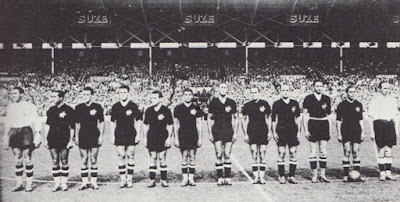 |
Photo
From: La Nazionale Italiana, 1978
(Italy
squad, Top, left to right: Aldo Olivieri , Michele Andreolo, Ugo Locatelli , Alfredo Foni, Pietro
Serantoni, Luigi ‘Gino’ Colaussi , Pietro Rava, Amedeo Biavati , Giovanni Ferrari, Silvio Piola, Giuseppe Meazza , June 12, 1938, World Cup, France 1-Italy 3)
|


