Showing posts with label qatar. Show all posts

Saturday, November 12, 2022

International Head-to-Head –Part Ten, Germany and Spain (with a video Interview with Spanish Economist and member of CIHEFE, Carles Lozano)


The World Cup is nearly here with Germany facing Spain in the First Round. This will be the fifth time the sides will have met in a World Cup setting.


In anticipation, or this Blog Presentation with an interview, I look back at the past encounters between the Nations.

The Interview will be as a video link companion, while the Blog will be a presentation of the events.


The Interviewee is:

Mr. Carles Lozano.


Mr. Lozano is a Spanish economist and former Catalan City Councilor. He is also a member of CIHEFE (El Centro de Investigaciones de Historia y Estadística del Fútbol Español), Spanish Center of Investigation Of Futbol History.


Mr. Lozano’s contact info:

Twitter: @carleslozano


My contact information:

on twitter @sp1873 and on facebook under Soccernostalgia.

https://linktr.ee/sp1873


1930s and 1940s

The first matches between the nations took place at a turbulent time in Europe’s History. Just prior to the War and during the Second World War itself.

The very first match was in Köln on May 12, 1935, and Spain won (2-1). The sides met in the following year at Barcelona (February 23, 1936). This time the Germans won (2-1).

The sides met at Berlin at the height of the War on April 12, 1942. This was a German side strengthened with Austrians. The match ended (1-1).


Photo From: Special Thanks to Josele Carbonell

(May 12, 1935, Germany 1-Spain)


Photo From: Special Thanks to Josele Carbonell

(February 23, 1936, Spain 1-Germany 2)


Photo From: Die Geschichte der Fussball Nationalmanschaft, Author: Dietrich Schulze-Marmeling (Hrsg)

(April 12, 1942, Germany 1-Spain 1)


Photo From: Österreichs Fußball Länderspiele Chronik 1902 – 1993, Author: Anton Egger

(April 12, 1942, Germany 1-Spain 1)


1950s and 1960s

The sides would meet three times in the first two decades of the post-war. By now, West Germany was a power in World Football.

On December 28, 1952, the Nations met at Madrid (2-2 tie). Later in the decade, on March 19, 1958, at Frankfurt, West Germany won (2-0). This was the first ever home win in the series.

The first competitive match between the Nations was during the Group Round in the 1966 World Cup. The sides met for the first time in a neutral venue at Birmingham, England. West Germany won (2-1) with a memorable closed angle volleyed goal by Lothar Emmerich.


Photo From: Special Thanks to Josele Carbonell

(December 28, 1952, Spain 2-West Germany 2)


Photo From: World Soccer, February 1970

(July 20, 1966, World Cup, West Germany 2-Spain 1)


1970s

By this decade, West Germany were established as a World Football power and had already won the World Cup once (1954) and reached a Final (1966).

During the entire decade the sides would be managed by Ladislao Kubala (for Spain) and Helmut Schoen (for West Germany, in charge until 1978).

The Nations faced one another five times in this decade (3 friendlies and two Euros matches).

On February 11, 1970, at Sevilla, Spain won (2-0) through a double strike by Arrieta. This was Spain’s first win since the initial 1935 match.

As part of the 1974 World Cup preparations as host, West Germany played two matches vs. Spain within months.

On November 24, 1973, at Stuttgart, West Germany earned a (2-1) win with a double strike from Jupp Heynckes.

On February 23, 1974, at Barcelona, Spain would win won (1-0).

The sides would meet one another on home and away Quarterfinal series for the 1976 UEFA European Championships. On April 24, 1976, at Madrid, the sides tied (1-1).

On May 22, 1976, at Munich, West Germany defeated Spain (2-0) and advanced to the Final phase of the Euros.


Photo From: Special Thanks to Josele Carbonell

(February 11, 1970, Spain 2-West Germany 0)


Photo From: AS Color, Issue 132, November 27, 1973

(November 24, 1973, West Germany 2-Spain 1)


Photo From: AS Color, Issue 258, April 27, 1976

(April 24, 1976, UEFA European Championships, Spain 1-West Germany 1)


Photo From: AS Color, Issue 262, May 25, 1976

(May 22, 1976, UEFA European Championships, West Germany 2-Spain 0)


Photo From: Fussball Magazin, Issue 6, September October 1977

(May 22, 1976, UEFA European Championships, West Germany 2-Spain 0)


1980s

The sides faced each other four times in the decade in mostly competitive matches (bar one friendly in 1986).

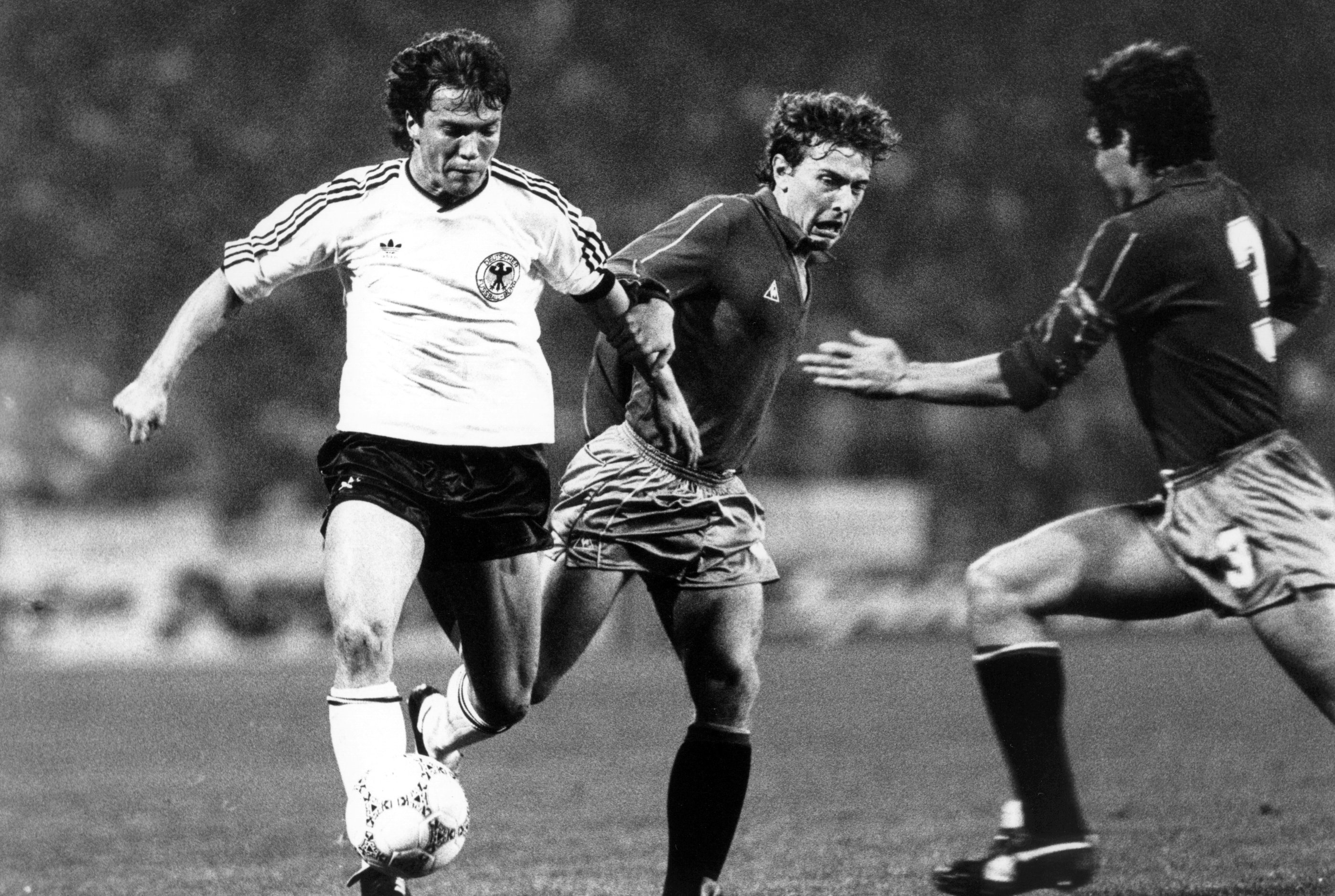
During the 1982 World Cup, hosted by Spain, the sides met in a Second Round Group phase match in Madrid on July 2, 1982. A disappointing Spain lost (1-2) on home soil and were virtually eliminated that day.

Two years later, on June 20, 1984, Spain defeated West Germany (1-0) in an upset win at Paris during the 1984 Euros. Antonio Maceda’s memorable header eliminated West Germany.

On October 15, 1986, in a friendly in Hannover, the sides met in a (2-2) tie.

The sides met once more in a Group phase match of the 1988 Euros, hosted by West Germany. On June 17, 1988, at Munich, Rudi Völler scored twice in a (2-0) West German win. This was the last match between the Nations with West Germany as the Nation would be re-unified with the Eastern part two years later.


Photo From: Foot Magazine, Issue 15, July 1982

(July 2, 1982, World Cup, Spain, Spain 1-West Germany 2)


Photo From: Onze, Issue 79, July 1982

(July 2, 1982, World Cup, Spain, Spain 1-West Germany 2)


Photo From: France Football, Issue 1994, June 26, 1984

(June 20, 1984, UEFA European Championship, France, West Germany 0-Spain 1)


Photo From: Mondial, new series, issue 52, July 1984

(June 20, 1984, UEFA European Championship, France, West Germany 0-Spain 1)


Photo From: Mondial, new series, issue 52, July 1984

(June 20, 1984, UEFA European Championship, France, West Germany 0-Spain 1)


Photo From: Special Thanks to Josele Carbonell

(October 15, 1986, West Germany 2-Spain 2)


Photo From: France Football, Issue 2202, June 21, 1988

(June 17, 1988, UEFA European Championship, West Germany 2-Spain 0)


1990s

Surprisingly the sides only met twice during the entire decade. The sides met for the third time in a World Cup on June 21, 1994, at Chicago in the United States. The match ended as a (1-1) tie that was beneficial to both sides. The match is remembered for Juan Goicoechea’s excellent cross/goal.

Months later, on February 22, 1995, the sides met in a friendly at Jerez de la Frontera. The match ended scoreless for the first (and only time) in the series.


Photo From: France Football, Issue 2516, June 28, 1994

(June 21, 1994, World Cup, Germany 1-Spain 1)


Photo From: Special Thanks to Josele Carbonell

(February 22, 1995, Jerez de la Frontera, Spain 0-Germany 0)


2000s

The sides met three times during this decade. The first two matches were friendlies, while the third was the Final of the 2008 Euros.

On August 16, 2000, for Rudi Völler’s very first match in charge of Germany at Hannover, Germany won (4-1). Mehmet Scholl and Alexander Zickler scored doubles with Raul replying for Spain.

Raul would score twice in the next match between the Nations on February 12, 2003, at Mallorca (Spain won (3-1)). This was Spain’s first win since the 1984 Euros.

On June 29, 2008, Spain defeated Germany (1-0) in the Final of the Euros with Fernando Torres’ strike.

This was Spain’s first International title since the 1964 Euros.

This was the reference point for the rebirth of Spain as a force at International level.


Photo From: Special Thanks to Josele Carbonell

(August 16, 2000, Germany 4-Spain 1)


Photo From: Onze-Mondial, Issue 234, July 2008

(June 29, 2008, UEFA European Championship, Spain 1-Germany 0)


Photo From: Onze-Mondial, Issue 234, July 2008

(June 29, 2008, UEFA European Championship, Spain 1-Germany 0)


Photo From: Onze-Mondial, Issue 234, July 2008

(June 29, 2008, UEFA European Championship, Spain 1-Germany 0)


2010s and 2020s

Two years later, the sides met again, this time in a World Cup semifinal. On July 7, 2010, at Durban in South Africa, Spain won (1-0) to advance to the Final of the World Cup (and win it for the first time).

The sides met in a friendly at Vigo on November 17, 2014. Germany won (1-0) with a Toni Kroos strike. This was Spain’s first home loss to Germany since the 1982 World Cup.

On March 23, 2018, the sides met at Düsseldorf. The match ended as a (1-1) tie. The first tied match since 1995.

In the year 2020, the sides met twice as part of the UEFA Nations League. The matches were played in empty stadiums due to the Coronavirus Lockdown.

The first match on September 3, 2020, at Stuttgart ended as a (1-1) tie.

The next match on November 17, 2020, at Sevilla, saw Spain inflict a (6-0) win over Germany with Ferrán Torres scoring a hat-trick. This was one of the heaviest defeats suffered by Germany.


Photo From: France Football, Issue 3352bis, July 9, 2010

(July 7, 2010, World Cup, Spain 1-Germany 0)


Photo From: Onze-Mondial, Issue 258, July 2010

(July 7, 2010, World Cup, Spain 1-Germany 0)


Photo From: L’Equipe, Year 75, No. 24144, Friday September 4, 2020

(September 3, 2020, 2020-21 UEFA Nations League, Germany 1-Spain 1)


Conclusion

On balance, the sides appear to be relatively equal in terms on wins and goals scored.

For most of the post-War era, Germany (West) had the edge and were one of the top sides in the World.

This changed from 2008 onwards, as Spain became a Force in World Football.

As far as the most memorable matches, the 1984 Euros match ranks as one of the most dramatic ones.

In terms of importance, the 2008 Euros Final and the 2010 World Cup semifinal are the most significant matches between the Nations.

In a way these two matches also signaled a power shift.

The recent (6-0) could be disregarded an anomaly. It was played during the Covid Lockdown era and was not a true indication of either side’s worth.


Note:

1-Please refer to the video link at the top of this blog upload for the interview.


Thursday, September 22, 2022

Soccer Memories-Part 44 (The New Annoying Trends of Modern Football (Soccer))

 In the recent years it feels like I am becoming an old man, as I look with disdain to the changes on and off the field regarding the game.

Nostalgia is always strong for fans of my age and there is always a tendency from every generation to look at the past in rose-tinted glasses.

I can look through my old magazines from 70s and 80s and there is a common thread in fans and even players of past generation looking back at the good old times.

A common complaint is usually about commercialization ruining the game.

If only these players (if still living) could see the changes of these last years.


As for myself, I do not exactly remember the reference point where I started noticing changes that disturbed me.

For my own amusement, I have tried to make a list. These could be major changes or even minor banal things that somehow rub me the wrong way.


Free Kicks with one player laying down horizontally

If you have seen any matches in the last few years, you have surely noticed this new trend on free kicks. Behind the wall, one of the players lays down across horizontally, to prevent any ground level shots, when the players in the wall automatically jump up.

This is a minor thing, but somehow it looks strange to someone used to the Football of a different era.


Photo From: https://news.paddypower.com/football-news/2021/05/14/taking-it-lying-down-how-to-find-the-perfect-player-behind-the-wall/

Players interrupting a winning Manager’s press conference

A new trend from these last years, the tournament winning Manager is giving his press conference and his players barge in and interrupt the press conference and pour champagne on him, etc. I don’t remember when or how this started, but I definitely do not remember such a trend in the past.


Initiation of new players

An initiation ceremony for new signings is that they have to sing a song in front of all the teammates. Maybe this tradition has always existed, I am not sure. However, filming this initiation and releasing on social media is definitly new.


Ruining of the Ballon d’Or

France Football magazine’s Ballon d’Or used to be the pinnacle for individual awards for a player. The winner would be announced the day of the magazine’s release. One of the appealing aspects of the voting was some of the odd selections by certain jurors, which always made it interesting.

This was changed when it was decided in the 90s to have a chosen selection of 50 players that the jurors could only vote for.

The award ceremony become a gala event akin to the Academy Awards and now there are additional awards associated with it: The Young player, Yashin,Award, etc.

Photo From: France Football, Issue 3837, December 3, 2019


Messi vs. Cristiano Ronaldo debate

One of the many ridiculous debates of the Social Media age is the comparison between Messi and Cristiano Ronaldo. Eager fans of each camp, young or old, will post the merits of one and denigrate the ‘shortcomings’ of the other. The truth is that we should be lucky that there are two players of exceptional quality who have marked their Generation.

Most of us lived in the age of Maradona and I barely recall comparisons of Maradona with other contemporaries in such a manner.


Devaluation of Magazines

I am from the generation that grew up with Football magazines. One of the greatest joys as a fan was rushing to newsstands in anticipation of the new issue of your Football magazine. This is an excitement that younger fans will never understand. At times, these magazines were the greatest source of knowledge and information. The internet changed this in the 90s and with the evolution of this medium and social media, magazines became secondary and not as influential as before. Nowadays, most people get their magazines on PDF and that’s not the same thing.


Photo From: https://www.facebook.com/Soccerretromag


The Expansion of UCL

I grew up in an era when European Cups were in knock-out format. There was such excitement with the Champions Cup, the Cup Winners Cup and the UEFA Cup.

Because of Economic reasons, the Champions Cup evolved into a Champions League. It grew to such an extent that the Cup Winners Cup was disbanded in 1999 and the UEFA Cup became a meaningless Tournament.

Personally, I felt something was not right during the 1999/00 season. This was the first season of the expanded Champions League with two Group phases and for the first time I felt too many matches were being played and it was getting difficult to follow and keep up like the old days. Alas, it seems like a Super League is on the horizon.


The Ruining of International Football

International Football was a favorite part of the game. We looked for anticipation for lineups, looking for new caps, etc. Friendly matches used to be exciting and fun to watch as much as qualifiers. Back then, you maybe had one match per month or so.

The expansion of the UCL took the shine of International Football. In addition, the increase in number of matches that Nations have to play has made it less interesting. Nowadays, some fans look upon with disdain to ‘International Breaks’, where Nations play up to three-four matches in the space of ten days or so, and look forward to the resumption of League play.

In addition, the creation of meaningless Tournaments like the ‘Nations League’ has further increased the slow death of International Football.


The Ruining of the Euros

The UEFA European Championships were once upon a time a quality Tournament only second in importance to the Word Cup. When the number of participants was increased to 16 for the 1996 Edition, it seemed like a fair balance. However, for the 2016 Edition, the number of participants was increased to 24 teams with predictable drop in quality. The 2020 Edition (played in 2021) was even more chaotic with venues spread across the continent and no actual host.


Team Group Photo in the Dressing Room

This new trend of a Group Team Photo in the Changing Room released in Social Media after an important win. This is a trend that is representative of the Social Media age, somehow you can’t imagine teams doing this in the good old days.


Photo From: https://www.mirror.co.uk/sport/row-zed/cristiano-ronaldo-dressing-room-photo-10324269


The Walk of Honor

I could be wrong about this one, but from what I remember, the Walk of Honor, was a tradition in Spain, whereby the opposing Team would lineup and applaud the League Champions as they entered the field. It was a sign of respect and Fair Play. Nowadays, it seems everyone from the kit man on is given a walk of honor in various Nations. I repeat this is a topic I might be wrong about, but I have noticed this trend more and more in the last few years. (Please, no insults if am wrong, just correct me)


Children mascot holding hands with players and players high-fiving before matches

I grew up in an era where the two teams would enter the field and the captains would shake hands at the beginning. Then after the match was over, the players would exchange kits, etc.

I cannot pinpoint when this trend started but I think it was in the 90s. You have the two teams coming on the field with each player holding hands with a child mascot. Then like in a high school game you have the players in a row high-five and embrace one another before the match. It’s just a cheesy ploy from ‘the suits’ to show they believe in Fairplay, etc. Of course, five seconds later the same players are kicking the lumps out of one another.


Teams having a multitude of kits

Until the mid-90s, teams used to have a home kit and an away kit. I would say for up to 70-80% of their matches (please don’t hold me to this percentage), teams would wear their home kit and only in rare cases, the away kit would be worn. For example, a team like Juventus would have worn their away kit, for perhaps a handful of matches in a season. Naturally, all this changed when replica kits became a big business and teams started having three or more kits per season. In some cases, special kits were worn specially for a particular competition. To justify the existence of these kits, teams started wearing their away and special kits on more and more occasions. Needless to say, to maximize profits from sales, the designs had to change, in some cases, from season to season.

Photo From: World Soccer, April 1994


Over-exposure of Friendly pre-season matches

For most of my time as a Football fan, pre-season friendlies were meaningless matches not taken seriously.  In fact, I don’t even remember if they were covered in print, much less television (exceptions for Unicef charity matches, prestige friendlies, etc).

However, we now live in age where clubs’ Pre-season Tours in USA are dissected by analysts and covered as important events. This is bearing in mind, that the transfer ends by the end of August and many of the players will have moved on from their clubs anyway.


VAR

VAR was introduced to correct refereeing errors for the good of the game. Its use has been controversial and has only increased complaints from the public. In some ways, refereeing errors were considered as part of the game and were rare. These errors were sometimes discussion points about the history of the game. Irrespective of its intentions, its disastrous application has made the public reminisce of the pre-VAR days.


Johnny-Come-Lately Football (Soccer) fans

Football (Soccer) is a game that gets in your blood when you’re young. Therefore, most real fans of the game have a disdain for people who magically become Football fans as adults just because the game has become trendy now. Globally, most of these fans ‘become’ massive English Premier League fans (due to its marketing strength) with no knowledge of the history of the game and the clubs.


Hollywood Stars ‘liking’ Soccer

Similar to the complaint above, nothing angers real fans of the game more than watching celebrities jump on the bandwagon and start liking the game, etc. It’s even more annoying when you see Hollywood celebrities who never grew up with the game and have no concept of its history, suddenly, become fans and start wearing the kits and will even go to matches (when on promotional tours in Europe).


Conclusion

I am sure if I think hard enough, I can come up with other examples as well. Some of these examples are minor and really meaningless in the grand scheme of things. They are the result of Social Media trends and will probably run their course.

As a long-term fan I always look to the Football of the past with fondness. One has to accept that there is always an evolution to the game. I imagine, someone else in thirty years will look with Nostalgia with the examples that I cited.