Sunday, September 29, 2024

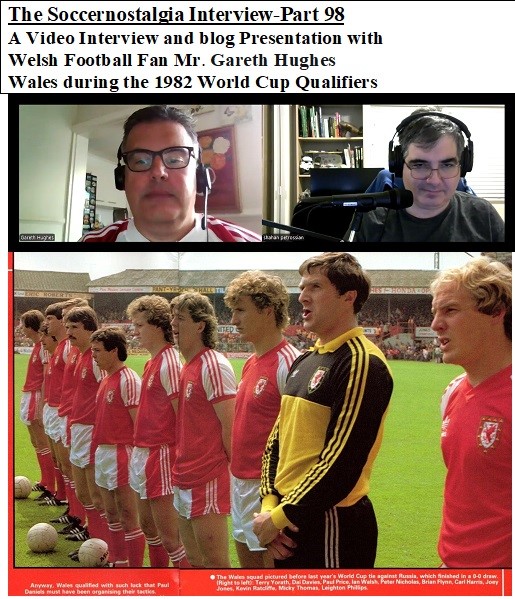
The Soccernostalgia Interview-Part 98- A video Interview and blog presentation with Welsh Football fan, Mr. Gareth Hughes, discussing Wales during the World Cup 1982 qualifiers.


For this interview, I look back at Wales’ 1982 World Cup qualification campaign.


The Interview will be as a video link companion, while the Blog will be a presentation of the events.

The Interviewee is:

Welsh Football fan, Mr. Gareth Hughes


Mr. Hughes’ contact info:

Facebook: https://www.facebook.com/gareth.hughes.37604

Twitter: @pontblyddyn


My contact information:

on twitter @sp1873 and on Facebook under Soccernostalgia.

https://linktr.ee/sp1873


Listen on Spotify / Apple:

 https://open.spotify.com/episode/311RGFZrtXNuJ8loXWNyto?si=0GxS-ImCQd65Km3bLidJng&nd=1&dlsi=d2cac5618f2a446d

https://podcasts.apple.com/us/podcast/the-soccernostalgia-interview-part-97-a-video/id1601074369?i=1000671226335


YouTube Link:


Blog Link:


Wales 1982 FIFA World Cup Qualifiers


As Wales prepared to participate in the 1982 World Cup qualifiers, it had been more than two decades since they had been present in the Finals of a major Tournament. To be precise, not since the 1958 World Cup in Sweden and the days of John Charles.


Former Wales National Team defender Mike England was appointed in March 1980 and his first major test were these qualifiers.

Wales were to be in a group with the Soviet Union, Czechoslovakia, Iceland, and Turkey.

The Soviets and Czechoslovaks were experienced campaigners with many Tournament participations in the previous years and decades and were naturally favored to advance.

Mike England had the 1980 Home Championship to try out his final experiments before their first qualifying match against Iceland in June 1980.

The Home Championships started well but ended in disappointment. These included the epic (4-1) win over England on May 17, 1980, followed by (0-1) losses to Scotland (May 21, 1980) and Northern Ireland (May 23, 1980, at Cardiff).

In the match against Scotland, new Liverpool striker Ian Rush became the second youngest Welsh cap at the age of 18 years and 214 days.

Wales had a backbone that included goalkeeper Dai Davies, Captain and future National Team manager Terry Yorath, Peter Nicholas, Joey Jones, Paul Price, David Giles, Ian Walsh, Brian Flynn, Leighton James, Mickey Thomas, and Leighton Phillips, among others.


The 1982 World Cup qualifiers started on June 2, 1980, with Iceland hosting the Welsh at Reykjavik. It would be a comfortable (4-0) win for Wales with Ian Walsh scoring twice, along with David Giles and a penalty kick by Flynn.

In the Autumn of 1980, Wales played its second qualifier at home at Cardiff on October 15, 1980, against Turkey. It would be another comfortable (4-0) win with Brian Flynn opening the scoring, followed by a penalty kick by Leighton James, who would also score the fourth goal and Ian Walsh.

Wales’s first major test was against Czechoslovakia on November 19, 1980, at Cardiff.

David Giles’s ninth minute goal was sufficient for Wales to register its third straight win and top the group. At this point, they had a realistic hope of qualification.


In the new year 1981, Wales continued its winning streak. They played a friendly on February 24, 1981, at Dublin, and defeated Republic of Ireland (3-1).

On March 25, 1981, Wales traveled to Ankara to face Turkey in their next qualifier. The Welsh earned their fourth straight win with a (1-0) win with a Carl Harris strike,

The World Cup dream in Spain seemed closer and closer.

Ahead of their next qualifier, Wales participated in the 1981 Home Championship. On May 16, 1981, at Swansea, they defeated Scotland (2-0). This was followed by a scoreless tie against England at Wembley on May 20, 1981.

Welsh faced the toughest opponent in the group, the Soviet Union at Wrexham on May 30, 1981. The match ended in a scoreless tie and perhaps this was the first major setback in their quest. A win would surely have qualified the Welsh.

They nevertheless seemed in a good position with nine points and no goals conceded up to that point.


Photo From: Mondial, new series, issue 16, July 1981

(May 30, 1981, World Cup Qualifier, Wales 0-USSR 0)


Photo From: Official Match Programme, England v Northern Ireland, 1984

(May 30, 1981, World Cup Qualifier, Wales 0-USSR 0)


Photo From: World Soccer, July 1981

(May 30, 1981, World Cup Qualifier, Wales 0-USSR 0)


It all started to fall apart for the Welsh in the Autumn of 1981. On September 9, 1981, Wales traveled to Prague and were defeated (0-2) by Czechoslovakia.

The Czechoslovaks were now a point behind with one less match and the Soviets still had five more matches to play.


Photo From: Start 1981 №39, Septembra 28, 1981

(September 9, 1981, World Cup Qualifier, Czechoslovakia 2-Wales 0)


Photo From: Start 1981 №39, Septembra 28, 1981

(September 9, 1981, World Cup Qualifier, Czechoslovakia 2-Wales 0)


Wales missed their best opportunity by failing to defeat Iceland at home, at Swansea, on October 14, 1981.

The match ended as a (2-2) tie against an opponent they had soundly defeated over a year before at Reykjavik.

This was a costly point dropped and Czechoslovakia and the Soviets would make up the ground.

In fact, when it came to Wales’s last match of the qualifiers, the Soviets had taken the leadership of the group with two matches to spare, with Wales just behind.

On November 18, 1981, at Tbilisi, the Soviets defeated the Welsh (3-0). At this point, Wales’s’ destiny was out of their hands. There remained one more match in the group with Czechoslovakia hosting the Soviets at Bratislava on November 29, 1981.

The Czechoslovaks had a superior goal difference to Wales and a tie would be sufficient to edge ahead of Wales on goal difference.

Czechoslovakia did just that by getting a (1-1) tie and qualified for the World Cup ahead of Wales.

Wales had come so close but were eliminated by two quality sides like USSR and Czechoslovakia.

There was much regret for not winning at home against Iceland and this ultimately doomed them.

They could look forward to future Tournaments, however, they did not build up on these relatively successful qualifiers and stagnated for the coming decades.


Wales players during the qualification matches


Goalkeepers:

William David ‘Dai’ Davies (Wrexham Football Club / Wales, registered in English League) and from 1981/82, (Swansea City Football Club / Wales, registered in English League) (April 1, 1948, Glanaman, Wales-February 10, 2021) (8 Matches)


Defenders:

Joseph Patrick Jones (Wrexham Football Club / Wales, registered in English League) (March 4, 1955, Llandudno, Wales) (7 Matches, substituted in 1 match)

Paul Terence Price (Luton Town Football Club / England), from 1981/82, (Tottenham Hotspur Football Club-London / England) (March 23, 1954, St Albans, Hertfordshire, England) (6 Matches)

Peter Nicholas (Crystal Palace Football Club-London / England) from 1981, (Arsenal Football Club-London / England) (November 10, 1959, Newport, Monmouthshire, Wales) (8 Matches)

Leighton Phillips (Swansea City Football Club / Wales, registered in English League) from 1981/82, (Charlton Athletic Football Club-London / England) (September 25, 1949, Neath, Wales) (7 Matches, substituted in 1 match)

Kevin Ratcliffe (Everton Football Club-Liverpool / England) (November 12, 1960, Mancot, Wales) (6 Matches)


Midfielders:

Brian Flynn (Leeds United Association Football Club / England) (October 12, 1955, Port Talbot, Glamorgan, Wales) (7 Matches)

Leighton James (Swansea City Football Club / Wales, registered in English League) (February 16, 1953, Loughor, Swansea, Wales) (6 Matches)

Terence Charles Yorath (Tottenham Hotspur Football Club-London / England) from 1981, (Vancouver Whitecaps / Canada) (March 27, 1950, Grangetown, Cardiff, Wales) (5 Matches, substituted in 1 match)

William Byron Stevenson (Leeds United Association Football Club / England) (September 7, 1956, Llanelli, Wales-September 6, 2007) (2 Matches and came on as substitute in 1 match)

David Charles Giles (Swansea City Football Club / Wales, registered in English League) (September 21, 1956, Cardiff, Wales) (5 Matches, substituted in 2 matches and came on as substitute in 2 matches)

Carl Stephen Harris (Leeds United Association Football Club / England) (November 3, 1956, Neath, Wales) (7 Matches, substituted in 3 matches and came on as substitute in 2 matches)

John Francis Mahoney (Swansea City Football Club / Wales, registered in English League) (September 20, 1946, Cardiff, Wales) (2 Matches, substituted in 1 match)


Strikers:

Michael Reginald ‘Mickey’ Thomas (Manchester United Football Club / England), September 1981, (Everton Football Club-Liverpool / England) and November 1981, (Brighton Hove and Albion Football Club / England) (July 7, 1954, Loughor, Mochdre, Wales) (4 Matches, substituted in 1 match and came on as substitute in 1 match)

Robert Mark James (Swansea City Football Club / Wales, registered in English League) (March 23, 1957, Swansea, Wales-February 18, 1998, Llanelli, Wales) (2 Matches and came on as substitute in 1 match)

Ian Patrick Walsh (Crystal Palace Football Club-London / England) (September 4, 1958, St David's, Wales) (7 Matches, substituted in 2 matches and came on as substitute in 1 match)

Gordon John Davies (Fulham Football Club-London / England) (August 3, 1955, Merthyr Tydfil, Wales) (1 Match and he was substituted in it)

Jeremy Melvyn Charles (Swansea City Football Club / Wales, registered in English League) (September 26, 1959, Swansea, Wales) (4 Matches and came on as substitute in 2 matches)

Alan Thomas Curtis (Swansea City Football Club / Wales, registered in English League) (April 16, 1954, Pentre, Rhondda, Wales) (3 Matches)

Ian James Rush (Liverpool Football Club / England) (October 20, 1961, St Asaph, Wales) (2 Matches and came on as substitute in 1 match)

Stephen John Lovell (Crystal Palace Football Club-London / England) (July 16, 1960, Swansea, Wales) (1 Matches and he came on as substitute in that match)


Coach: Harold Michael England (December 2, 1941, Holywell, Flintshire, Wales)


Photos From:
Panini England 1977/78 (Joey Jones, Leighton Phillips)
Panini England 1980/81 (Curtis, Harris, Yorath)
Panini England 1981/82 (Flynn, Giles, Charles, Leighton James, Mahoney, Price, Ratcliffe, Robbie James, Stevenson, Mickey Thomas, Nicholas)
Panini England 1983/84 (Rush)
Panini England 1986/87 (Gordon Davies)
FKS 74-75 (Mike England)
FKS 75-76 (Dai Davies)
FKS 80-81 (Ian Walsh)

Missing (Stephen John Lovell)


Thursday, September 19, 2024

Soccernostalgia Talk Podcast-Episode 137 (Interview with English Author and Podcaster Mr. Rob Fletcher, discussing his book ‘Chaos, Controversy and THAT Kung-Fu Kick: 94/95 The Premier League's Most Dramatic Season’ (2024))

 This is the 137th episode of my podcast with Mr. Paul Whittle of https://the1888letter.com/, @1888letter.


For this episode, we interview English Author and Podcaster Mr. Rob Fletcher, discussing his book ‘Chaos, Controversy and THAT Kung-Fu Kick: 94/95 The Premier League's Most Dramatic Season’ (2024).


This book covers the 1994/95 English Premier League season.


Mr. Fletcher is the editor of Boro Mag, a podcast and publication about Middlesbrough FC. He has written for many outlets such as The Football Pink, KIT Magazine, Futbolista among others.


His other book is: ‘1992: The Birth of Modern Footbal’ (2023)


For any questions/comments, you may contact us:

You may also contact me on this blog, on twitter @sp1873 and on facebook under Soccernostalgia.

https://linktr.ee/sp1873


Mr. Paul Whittle, @1888letter on twitter and https://the1888letter.com/contact/

https://linktr.ee/BeforeThePremierLeague


You may also follow the podcast on spotify and Apple podcasts all under ‘Soccernostalgia Talk Podcast’

Please leave a review, rate and subscribe if you like the podcast.

Mr. Fletcher’s contact info:

Twitter: @rob_fletcher_

Twitter: @9495_Book

Twitter: @boro_mag

Linktree: https://linktr.ee/boromag

Link to Mr. Fletcher’s books:

https://www.amazon.co.uk/Chaos-Controversy-THAT-Kung-Fu-Kick/dp/1801507465

https://www.pitchpublishing.co.uk/shop/chaos-controversy-and-kung-fu-kick#:~:text=Description,into%20the%20Selhurst%20Park%20crowd.

https://www.amazon.co.uk/dp/1801504288?ref_=cm_sw_r_apin_dp_ZA76W70JKJ0GH9N21AXC


Listen on Spotify / Apple Podcasts:

https://open.spotify.com/episode/7ChuMUe0P1ONTVfwmlrS7S?si=7JUZ6Z7ySi-T-yyMp9Y2bg&nd=1&dlsi=06a45446dc1741a2

https://podcasts.apple.com/us/podcast/soccernostalgia-talk-podcast-episode-137-interview/id1601074369?i=1000670110739


Tuesday, September 17, 2024

Soccernostalgia Talk Podcast-Episode 136 (Interview with Author Mr. Dominic Hougham, discussing his book ‘Fifty Great World Cup Matches: …and Why You Should Watch Them! (2024))

 This is the 136th episode of my podcast with Mr. Paul Whittle of https://the1888letter.com/, @1888letter.


For this episode, we interview Author Mr. Dominic Hougham as we discuss his book ‘Fifty Great World Cup Matches: …and Why You Should Watch Them!


Mr. Hougham has written for These Football Times and The Football Pink.


For any questions/comments, you may contact us:

You may also contact me on this blog, on twitter @sp1873 and on facebook under Soccernostalgia.

https://linktr.ee/sp1873


Mr. Paul Whittle, @1888letter on twitter and https://the1888letter.com/contact/

https://linktr.ee/BeforeThePremierLeague


You may also follow the podcast on spotify and Apple podcasts all under ‘Soccernostalgia Talk Podcast’

Please leave a review, rate and subscribe if you like the podcast.

Mr. Hougham’s contact info:

Twitter: @DominicHougham

Link: https://thesefootballtimes.co/author/dominic-hougham/

Link to Mr. Hougham’s book:

https://www.amazon.com/Fifty-Great-World-Cup-Matches/dp/1801507244?ref_=ast_author_dp

https://www.amazon.co.uk/Fifty-Great-World-Cup-Matches/dp/1801507244

https://www.pitchpublishing.co.uk/shop/fifty-great-world-cup-matches


Listen on Spotify / Apple Podcasts:

https://open.spotify.com/episode/3qbCUCmutxpdf70sG5UDgl?si=yqAL6FftQkqm-n9Dyf_CaQ&nd=1&dlsi=467b9bf17cf5440f

https://podcasts.apple.com/us/podcast/soccernostalgia-talk-podcast-episode-136-interview/id1601074369?i=1000669881423


Saturday, September 14, 2024

The Soccernostalgia Interview-Part 96- A video Interview and blog presentation with Scottish Author Mr. Matt Corr, discussing Celtic Glasgow’s run in the 2002/03 season of the UEFA Cup)


 For this interview, I look back at Celtic Glasgow’s run in the 2002/03 season of the UEFA Cup.

The Interview will be as a video link companion, while the Blog will be a presentation of the events.

The Interviewee is:

Scottish Author Mr. Matt Corr


Mr. Corr is the Author Celtic Glasgow related books:

Invincible (2023), Harry Hood: Twice As Good (2022)

And co-Author of Walfrid & The Bould Bhoys: Celtic's Founding Fathers, First Season & Early Stars (2022)


Mr. Corr’s contact info:

Twitter: @Boola_vogue

Link to books:

https://celticstarbooks.com/product/invincible-by-matt-corr/

https://www.amazon.co.uk/Matt-Corr/e/B089MBL1BM%3Fref=dbs_a_mng_rwt_scns_share


For more Celtic Glasgow related books, also check out:

https://celticstarbooks.com/


Listen on Spotify / Apple Podcasts:

https://open.spotify.com/episode/3xAyhTdilwmqKrcNI4FJYB?si=82oKLEVtQauHACkt7wNgSA

https://podcasts.apple.com/us/podcast/the-soccernostalgia-interview-part-96-a-video/id1601074369?i=1000669534965


Celtic FC in the UEFA Cup 2002/03


When the 2002/03 season kicked off, Celtic Glasgow had the opportunity to play in the group stages of the Champions League as 2002 Scotland Champions.

However, they were eliminated by Swiss side Basel in August 2002 and had to drop down into the UEFA Cup.

Little did they know that this would be a memorable adventure despite the ultimate defeat in the Final in May 2003.

Celtic were managed by Northern Irish Manager Michael O'Neill, who since arriving in 2000 had transformed the club.

The side had won the 2001 and 2002 Scottish Champions. They were a force featuring the goalscoring talents of Swedish striker Henrik Larsson. The side also included the likes of English striker Chris Sutton, Welsh striker John Hartson, Bulgarian midfielder Stilian Petrov, Scottish midfielder Paul Lambert and the Northern Irish midfielder Neil Lennon just to name a few.

The transfer activity was light in the offseason. The arrivals included Swedish goalkeeper Magnus Hedmann (from Coventry City), Danish defender Ulrich Laursen (from Hibernian) and Spanish striker David Fernandez (from Livingston).


The First round of the UEFA Cup was easy for Celtic as they faced Lithuanian side FK Sūduva. On September 19, 2002, Celtic won (8-0) at home and (2-0) away on the return fixture on October 3rd.


For the Second round, they faced English side Blackburn Rovers, managed by Graeme Souness.

On October 31, 2002, at home, Celtic won (1-0) through a late Henrik Larsson goal. For the Return Leg, at Blackburn on November 14th, Celtic came away with a (2-0) win.


Photo From: Official Match Programme, Liverpool v. Celtic 2003

(October 31, 2002, UEFA Cup, Celtic Glasgow 1-Blackburn Rovers 0)


Photo From: Official Match Programme, Celtic v. Liverpool 2003

(November 14, 2002, UEFA Cup, Blackburn Rovers 0- Celtic Glasgow 2)


For the Third round, Celtic faced tougher opposition in Spanish side Celta Vigo.

On November 28, 2002, at home, Celtic won (1-0) through a Henrik Larsson strike.

In the Return Leg, at Vigo, on December 12th, Celtic lost (1-2) but squeezed through due to the away goals rule, thanks to Hartson’s precious away strike.


Photo From: World Soccer, January 2003

(November 28, 2002, UEFA Cup, Celtic Glasgow 1-Celta Vigo 0)


As the season reached its midpoint, Celtic were in a tight battle with Rangers Glasgow for the Scottish League title.

The European adventure was unexpected, as Celtic had been anonymous in Europe for decades.


The new calendar year 2003, started with the One Eighth Finals of the UEFA Cup.

For this round, Celtic faced German side VfB Stuttgart. On February 20, 2003, at home, Celtic won (3-1) to gain the advantage. A week later on February 27th, at Stuttgart, Celtic put the tie away by scoring twice in the first quarter of an hour. Stuttgart staged a comeback and did eventually win (3-2) but Celtic were through.


The Quarterfinals appeared to be Celtic’s toughest test as they faced English opponents Liverpool.

On March 13, 2003, at home, Celtic were held to a (1-1) draw as Emile Heskey quickly ruled out Henrik Larsson’s early strike.

Liverpool appeared as favorites for the Return Leg, at Anfield on March 20th, however, Celtic showed its growing confidence in Europe by winning (2-0) and advancing.


Photo From: Official Match Programme, Liverpool v. Celtic 2003

(March 13, 2003, UEFA Cup, Celtic Glasgow 1-Liverpool 1)


Photo From: World Soccer, May 2003

(March 20, 2003, UEFA Cup, Liverpool 0- Celtic Glasgow 2)


In the Semifinals, Celtic’s opponents were the Portuguese side Boavista. On April 10th, 2003, at home, just like against Liverpool, Celtic were held to a (1-1) tie.

For the Return Leg at Porto, on April 24th, Celtic came away with an away (1-0) win through a late Henrik Larsson’s strike.


Photo From: World Soccer, July 2003

(April 24, 2003, UEFA Cup, Boavista 0- Celtic Glasgow 1)


Photo From: France Football, Issue 2980, May 20, 2003 


For the Final, on May 21, 2003, at Sevilla in Spain, Celtic faced Portuguese giants Porto, managed by a then unknown Jose Mourinho.

Celtic went into this match with one eye on the League title as the final matchday of the Scottish season was to be played on the following Sunday.

Porto took the lead through Derlei in the 45th minute. Just two minutes into the second half, Henrik Larsson tied the match.

Porto’s Russian midfielder Dmitriy Alenichev gave Porto the lead once more in the 54th minute. Henrik Larsson came through again, just minutes later, and tied the match (2-2) in the 57th minute.

The match had to go to extra time and Derlei would finally give Porto the go-ahead goal in the 115th minute.


Photo From: France Football, Issue 2980bis, May 23, 2003

(May 21, 2003, UEFA Cup, Porto 3-Celtic Glasgow 2)


Porto were UEFA Cup Champions and would win the Champions League in the following season.

Afterwards, the Celtic contingent including the Martin O’Neill complained of Porto’s gamesmanship.

Celtic’s disappointment was compounded on the following Sunday, as Rangers won the League title on goal difference.

Celtic had let two trophies out of their grasp. The European run may have cost them the League title and the stress of the final League match may have affected their Final against Porto.

Regardless, it had been a particularly good season for Celtic in Europe. This had been their first ever Final since the 1970 Champions Cup.


Photo From: France Football, Issue 2980, May 20, 2003

(Celtic Glasgow squad 2002/03)


The Celtic Football Club-Glasgow (2002/03 season):

Players who took part in these matches (on the field or on the bench and on the books):

Goalkeeper:

1- Jonathan Gould (July 18, 1968, Paddington) (aged 34 years old at the time) (left in January 2003 to Preston North End / England)

20-Robert ‘Rab’ Douglas (April 24, 1972, Lanark) (aged 30-31 years old at the time)

21- Magnus Hedman (Sweden) (March 19, 1973, Huddinge, Sweden) (aged 29-30 years old at the time)

22-David James Marshall (March 5, 1985, Glasgow) (aged 17-18 years old at the time)

26-Francisco Javier Sánchez Broto (Spain) (August 25, 1971, Barcelona, Spain) (aged 31 years old at the time) (arrived January 2003)

Barry John Corr (January 13, 1981, Glasgow) (aged 21-22 years old at the time)


Defenders:

3- Mohammed Sylla (Guinea) (March 13, 1977, Bouaké, Ivory Coast) (aged 25-26 years old at the time)

4- Jackie McNamara (October 24, 1973, Glasgow) (aged 28-29 years old at the time)

5- Joos Valgaeren (Belgium) (March 3, 1976, Leuven, Belgium) (aged 26-27 years old at the time)

6- Dianbobo Baldé (Guinea) (October 5, 1975, Marseille, France) (aged 26-27 years old at the time)

16-Ulrik Laursen (Denmark) (February 28, 1976, Odense, Denmark) (aged 26-27 years old at the time)

17-Didier Agathe (France) (August 16, 1975, Saint-Pierre, Réunion) (aged 27 years old at the time)

23-Stanislav Varga (Slovakia) (October 8, 1972, Lipany, Czechoslovakia) (aged 29-30 years old at the time) (arrived in February 2003)

35-Johan Mjällby (Sweden) (February 9, 1971, Järfälla, Sweden) (aged 31-32 years old at the time)

35- Thomas Boyd (November 24, 1965, Glasgow) (aged 36-37 years old at the time)

40-Stephen Crainey (June 22, 1981, Glasgow) (aged 21 years old at the time)

41-John Kennedy (August 18, 1983, Airdrie) (aged 18-19 years old at the time)

Ryan McCann (September 21, 1981, Blantyre) (aged 20-21 years old at the time) (returned from loan in January 2003)


Midfielders:

8-Alan Thompson (England) (December 22, 1973, Newcastle upon Tyne, England) (aged 28-29 years old at the time)

11-Colin Healy (Republic of Ireland) (March 14, 1980, Cork, Ireland) (aged 22-23 years old at the time)

14- Paul Lambert (August 7, 1969, Glasgow) (aged 33 years old at the time)

15-Bobby Petta (Holland) (August 6, 1974, Rotterdam, Netherlands) (aged 28 years old at the time)

18-Neil Lennon (Northern Ireland) (June 25, 1971, Lurgan, County Armagh, Northern Ireland) (aged 31 years old at the time)

19-Stilian Petrov (Bulgaria) (July 5, 1979, Montana, Bulgaria) (aged 23 years old at the time)

22-Stéphane Bonnes (France) (February 26, 1978, Mulhouse, France) (aged 24-25 years old at the time)

29-Shaun Richard Maloney (January 24, 1983, Miri, Malaysia) (aged 19-20 years old at the time)

30-Steve Guppy (England) (March 29, 1969, Winchester, Hampshire, England) (aged 33-34 years old at the time)

34-Mark Fotheringham (October 22, 1983, Dundee) (aged 18-19 years old at the time)

39-Jamie Smith (November 20, 1980, Alexandria) (aged 21-22 years old at the time)

43-Liam Miller (Republic of Ireland) (February 13, 1981, Cork, Ireland-February 9, 2018, Cork, Ireland) (aged 21-22 years old at the time)

Michael Doyle (Republic of Ireland) (August 8, 1981, Dublin, Ireland) (aged 21 years old at the time)

Jon-Paul McGovern (October 3, 1980, Glasgow) (aged 21-22years old at the time) (Loaned to Sheffield United)


Forwards:

7- Henrik Larsson (Sweden) (September 20, 1971, Helsingborg, Sweden) (aged 30-31 years old at the time)

9-Chris Sutton (England) (March 10, 1973, Nottingham, England) (aged 29-30 years old at the time)

10- John Hartson (Wales) (April 5, 1975, Swansea, Wales) (aged 27-28 years old at the time)

32-Simon Lynch (May 19, 1982, Montreal, Quebec, Canada) (aged 20-21 years old at the time) (left in January 2003 to Preston North End / England)

37-David Fernández Miramontes (Spain) (January 20, 1976, La Coruña, Spain) (aged 26-27 years old at the time)

Note:

1-In another source,

David Fernandez is number 12.

Colin Healy is number 24.

Tom Boys is number 2.


Coach: Martin Hugh Michael O'Neill (Northern Ireland) (March 1, 1952, Kilrea, Northern Ireland) (aged 50-51 years old at the time)

Team Captain: Paul Lambert

Official Kit Supplier/Designer: Umbro

Shirt Sponsor: ntl / ntl: home Digital TV


Transfer Activity:


Arrivals:

David Fernández (Livingston FC)

Magnus Hedman (Coventry City / England)

Ulrik Laursen (Hibernian FC)

Michael Doyle (back from loan from Aarhus GF (Denmark))

Liam Miller (back from loan from Aarhus GF (Denmark))

Stanislav Varga (Sunderland AFC / England) (arrived in February 2003)

Ryan McCann (back from loan in January 2003, from St. Johnstone FC)

Sánchez Broto (arrived in January 2003 from Livingston FC)

Paul Shields (back from loan in January 2003, Queen Of The South)


Departures:

Simon Lynch (left in January 2003 to Preston North End / England)

Jonathan Gould (left in January 2003 to Preston North End / England)


References:

France Football, Issue 2980, May 20, 2003

France Football, Issue 2980bis, May 23, 2003

Onze-Mondial, Issue 171, April 2003

Onze-Mondial, Issue 173, June 2003

World Soccer, May 2003

World Soccer, July 2003