Showing posts with label morten olsen. Show all posts

Tuesday, October 24, 2017

Transfers that did not happen, Part Twenty

1- In 1976, Juventus had attempted to sign Fiorentina’s Giancarlo Antognoni. However, the alleged response of one Fiorentina Official was that they would sell the Dome before selling Antognoni.

Photo From:  Mondial, New series, issue 8, November 1980
(Giancarlo Antognoni)


2-In January 1990, Derby County attempted to sign Colombia’s Leonel Alvarez. However, the deal fell through as Colombia had many friendlies and tours lined up in preparations for the 1990 World Cup.

Photo From:  Panini, World Cup, 1990
(Leonel Alvarez)


3- In December 1985, it was reported that Internazionale Milano wanted to appoint Alex Ferguson as Manager. The deal went nowhere was Ferguson had to prepare the Scottish National Team for the 1986 World Cup following the death of Jock Stein.

Photo From: Goal, Issue 13, October 1996
(Sir Alex Ferguson)


4- In April 1979, it was reported that Schalke’s Rudiger Abramczik ahd an offer to join Sporting Djeddah in Saudi Arabia (managed by the West German Dettmer Cramer). However, Abramczik stayed put.


Photo From:  Fussball Magazin, Issue 6, September October 1977
(Rudiger Abramczik)


5- In 1972, Denmark’s Morten Olsen had an offer to join Bundesliga’s Fortuna Dusseldorf. However, he chose Cercle Brugge in Belgium, as he wanted a more modest start to his professional career. 

Photo From: Foot Magazine, Issue 23, April 1983
(Morten Olsen at Anderlecht)

Wednesday, January 6, 2016

Soccer Memories-Part 30-Sepp Piontek’s Denmark: We Are Red, We Are White, We Are Danish Dynamite

When one evokes Denmark in Footballing terms, most people’s thoughts immediately turn to the early to mid 1980s when a West German Manager molded one of the most memorable teams in the history of the game.
Into the 1970s, Sweden was the only Scandinavian Nation that would qualify for the Finals of a Major Tournament on a semi-regular basis. Denmark (much like neighboring Norway) still did not have a fully professional League.
Periodically, a player would make enough of an impression that a Bundesliga club and/or a Dutch/Belgian club would take a gamble on.
However, the emergence of one player would further the cause of most Danish players hoping to make it in the Western Professional leagues.
Allan Simonsen would take the Bundesliga by storm and help Borussia Moenchengladabch win titles in domestic and European level. The continent would take notice and he would be rewarded with the Ballon d’Or in 1977. He was the rare exception of a Dane, who was viewed to be able to hold his own (and even surpass) with the best of the continent. He was the equivalent of a George Best or George Weah, a superstar who had the misfortune to be representing a Nation that could not qualify for the Finals of a Major Tournament.
While Simonsen was shining on the field, a more significant event took place off the field for Denmark. In the summer of 1979, former West German defender Josef ‘Sepp’ Piontek was appointed as the new Manager of the Danish National Team.

Photo From: Onze, Issue 102, June 1984
(Sepp Piontek)

He instilled discipline into the squad and demanded a more professional approach from his players. He displayed his authority by dropping the seemingly untouchable goalkeeper Birger Jensen of Club Brugge for missing an International match.
In time, he would also learn to ease up and adjust his methods to take into consideration the Danish players’ mentality.
He had been appointed well into the 1980 Euro qualifiers and could make no impact in a group that was eventually won by England.
The 1982 World Cup qualifiers were the first qualifiers that Denmark embarked on with Piontek.
His team already included a backbone of players that would serve him for the years to come.
In addition to Simonsen (now at Barcelona), Søren Busk, Jens Jørn Bertelsen, Klaus Berggreen, Morten Olsen, Søren Lerby, Frank Arnesen, and Preben Elkjaer-Larsen were already integral parts of the group and for the most part had experience playing in the Western Leagues.

Photo From: Onze, Issue 102, June 1984
(Allan Simonsen)

They were drawn in a qualifying with Italy, Yugoslavia, Greece and Luxembourg.
They started poorly and all hopes of qualification were lost as early as the Fall of 1980, when they lost their first three matches to Yugoslavia, Italy and Greece (at home).
All that remained was to salvage some pride and built up a team for the future in 1981.
The first notice that they showed that they were a team in the making was when they faced Italy at Copenhagen on June 3, 1981.  They outplayed and defeated the future World Cup Champions (3-1). Impressive victories in the month of June at Copenhagen would be the hallmark of this squad.
It was during the 1984 Euro qualifiers that this generation would come of age and really make its mark.
In a group that contained two recent World Cup participants England and Hungary (but also Greece and Luxembourg again), they were not favored.
The English, now managed by Bobby Robson, headed to Copenhagen for the first qualifier on September 22, 1982. They English led twice through Trevor Francis, but Denmark fought back each time and snatched an equalizer in the last minute. While, for the English, an away point seemed like a good result, the Danes had impressed and gained confidence.
For some time, into the Spring, English seemed set to qualify but Denmark kept pace by picking up wins vs. Greece and Luxembourg.
On June 1st, 1983, they defeated Hungary (3-1) at Copenhagen to set themselves up as England’s main rival for the group.
The rise of Danish football was further evidenced with two important transfers during that summer of 1983. Søren Lerby joined West German powerhouse Bayern Munich (from Ajax) to act as the midfield General as a replacement for the retiring Paul Breitner. In addition, the talented teenager Michael Laudrup joined Juventus (after turning down Liverpool), though he would be loaned to Lazio for two seasons.
Michael Laudrup underlined his rising star status by scoring twice in a friendly vs. France on September 7th, 1983 (3-1 win).
The stage was set for the key match in the Group between Denmark and England at Wembley on September 21st.
The Danes took the option on the Group by inflicting a rare defeat on England at Wembley with an Allan Simonsen penalty kick.

Photo From: Sport Illuestrierte, Fussball 1984 Sonderheft
(Allan Simonsen’s penalty kick, September 21, 1983, EC Qualifier, England 0-Denmark 1)

Many observers view this match as the Reference point when this Generation was born.
They suffered a minor hiccup, the following month after losing to Hungary at Budapest. After the win at Wembley, their destiny was always in their hands and they qualified for the Finals after defeating Greece in Athens in November.
The Qualification had given rise to a sense of euphoria, as well as, praise from other Nations due to the positive and exciting brand of Football.
However, the Danes did not possess a deep reservoir of talent. This handicap was exemplified in their (0-6) defeat vs. Holland in a friendly in March 1984. The Danish were missing many first team regulars and it was clear that they could not afford to lose many key players, as they could not call upon adequate replacements from the local Danish league.
This friendly was a major wake-up call; nevertheless Piontek was confident in his team’s chances with everyone being fit and available.
In the lead up to the Euros, the Danes suffered further defeats vs. Spain and Czechoslovakia, but Piontek still maintained confidence in his squad.
In the Euros, they were to play vs. hosts France in the Tournament curtain raiser in Paris. In a hard fought match that they narrowly lost (0-1), Denmark showed it could compete and hold its own with the Competition’s favorites.
Unfortunately, Allan Simonsen was severely injured in the match in a collision. This injury blighted the rest of his career and he was no longer as effective as before (not to mention ageing).

Photo From: Onze, Hors serie 26, 1986
(Soren Lerby, November 13, 1985, World Cup Qualifier, Republic of Ireland 1-Denmark 4)

Denmark picked up the pieces and destroyed Yugoslavia (5-0) in their next match and dazzled the Global audience with their now customary attacking style of Football.
The third match in the Group was vs. Belgium, whom they had to defeat to advance. Denmark fell behind (0-2), but stormed back to win (3-2) with Preben Elkjaer scoring the winner near the end.
The Semifinal vs. Spain ended in disappointment as Denmark lost in penalty kick shoot-out with Elkjaer missing his decisive kick.
Spain would turn out to be Denmark’s bogey team for the years to come.
Despite the loss, Denmark had been one of the revelations of the Tournament. Players like Lerby, Arnesen, Morten Oslen, Elkjaer, Berggreen and Laudrup were now household names. Elkajer’s displays earned him a transfer to Italy’s  Serie A and he joined Verona.
They had also left a positive impression with their fans nicknamed ‘Roligans’, who always cheered their team on and were well behaved and never caused any trouble.
Denmark went into the 1986 World Cup qualifiers with confidence as one of Europe’s finest teams, in a Group with USSR, Switzerland, Republic of Ireland and Norway.

Photo From: Mondial, new series, issue 53, August 1984
(Michal Laudrup)

They never seemed in danger and won the Group by scoring 17 goals in the process. The highlight of the Group was their win over the Soviet Union (4-2) at Copenhagen on June 5, 1985, that has been described as one of the finest matches in the History of the Game.  In a game where both sides attacked from start to the end, Laudrup and Elkjaer each scored twice.
They entered their first ever World Cup as one of the Tournament favorites. They once again dazzled the World audience in the first round, in the Group of Death with West Germany, Uruguay and Scotland. After defeating the Scots (1-0), they simply destroyed Uruguay (6-1) with an anthology goal from Laudrup.
They defeated their German rivals in the third match (2-0), where Allan Simonsen played his only World Cup match after coming on as a substitute.

Photo From: Onze, Issue 108, December 1984
(Preben Elkjaer)

In the knockout round, they faced Spain of Emilio Butragueno. The Danes went ahead from a Jesper Olsen penalty kick, however, the same player was guilty of an erroneous pass that allowed Butragueno to equalize. After that the Danish squad, uncharacteristically, capitulated and Spain defeated Denmark with a heavy score of (1-5, four goals by Butragueno).
Despite this defeat, they had left enough of a good impression in the first round, to be praised overall.
In some ways, perhaps this was the moment that Piontek’s great side started to decline (but more about that later).
With a more or less intact squad, the Danes entered the 1988 Euro qualifiers in a seemingly easy Group with Wales, Czechoslovakia and Finland.
Denmark naturally won this Group and qualified to the Finals in West Germany. Yet, there was a feeling that something was missing. Large and exciting wins were replaced with (1-0) wins and ties. The emergence of talent such as Peter Schmeichel, Flemming Povlsen, John Jensen, Jan Heintze and Lars Olsen was welcoming; however, regulars such as Morten Olsen, Lerby, Arnesen and Elkjaer were showing signs of age.

Photo From: Onze, Issue 129, September 1986
(Frank Arnesen and Jesper Olsen, June 4, 1986, World Cup, Denmark 1-Scotland 0)

Denmark entered the 1988 Euros and lost all its three matches vs. Spain (again!), West Germany and Italy. Their displays were unimpressive and even Piontek at the time hinted that an era had ended.
Following the Euros, some of the old guard stepped aside (Jesper Olsen, Morten Olsen, Lerby, Busk, Ivan Nielsen and Elkjaer).
Piontek persevered with the national team to guide them through the 1990 World Cup qualifiers in a Group with Romania, Bulgaria and Greece.
Michael Laudrup’s younger brother Brian was now part of the National Team setup. Others such as Lars Olsen, Schmeichel, Jensen and Vilfort now had leading positions guided by veterans such as Michael Laudrup and John Sivebaek.
Denmark, still in a rebuilding phase, stuttered early on in the qualifiers and managed (1-1) ties in its first two matches in the Fall of 1988 vs. Greece and Bulgaria (at home).
Things started looking brighter in the Spring of 1989, an away win at Bulgaria (2-0) was followed by a (7-1) win vs. Greece at Copenhagen.
In June 1989, for a Triangular Tournament in celebrations of the Anniversary of the Danish Federation, heavy defeats were inflicted on Sweden (6-0) and an under strength Brazil (4-0).

Photo From: Onze-Mondial, Issue 21, October 1990
(Morten Olsen, June 17, 1988, European Championships, Italy 2-Denmark 0)

For an instant it seemed like ‘Danish Dynamite’ was back on track. When they defeated Romania (3-0) in October, they even looked odds on favorites to qualify for the World Cup.
However, their limitations were exposed in the return match in November vs. Romania at Bucharest (1-3). Romania clinched the Group and qualified for the World Cup. Denmark had failed to qualify for the Finals of a Tournament after three straight qualifications.
The Press declared this as the loss that ended an era begun at Wembley in September 1983. But perhaps the goal glut of 1989 was just a mirage. They had defeated a weakened Greece and a B-C level Brazil team on tour. With a closer look, it was clear that ever since the loss vs. Spain in Mexico in 1986, they had been stagnating and declining.
After initially appearing that he might stay on, Piontek bowed out after the Press criticized his contract and salary. He became the Manager of the Turkish National Team in the new year (1990).
In over a decade in charge, Sepp Piontek had molded one of the best sides in Europe. There are teams that owe their immortality through the number of titles won. Then there are teams that despite not winning trophies stay in our memories for the sheer joy that they gave the Audience.
Denmark of the 1980s is in this category along with the likes of the 1954 Hungarians, the Dutch of the 1970s and Brazil of 1982.

Richard Möller-Nielsen, Piontek’s successor, actually did clinch a title (the 1992 Euros). But chances are that it is the 1980s squad that the public actually remembers to this day.

Photo From: (Magazine Source unknown) / Contribution From a blog viewer
(Denmark squad, Top, left to right: Ole Qvist,  Soren Lerby, Michael Laudrup, Soren Busk,   Frank Arnesen,  Bottom, left to right: Preben Elkjaer, Jens Jorn Bertelesen,  Ivan Nielsen, Klaus Berggreen, Morten Olsen , Jesper Olsen ,  June 5, 1985, World Cup Qualifier, Denmark 4-USSR 2)

Saturday, August 15, 2015

Memorable European Confrontations, Part 22-1983 Anderlecht vs. RC Lens

Anderlecht and RC Lens were paired in the Third Round of the 1983/84 UEFA Cup.
The Belgian Club Anderlecht, managed by the former star Paul van Himst, were the defending Champions of the trophy and one of Europe’s stronger teams.
The squad contained many Internationals from different nations which included Belgians Frankie Vercauteren, Erwin vandenbergh, Rene vandereycken , as well as a large Danish contingent led by Morten Olsen and Frank Arnesen.
They had qualified from their opening Rounds by defeating Norway’s Bryne (3-0 away, 1-1 ) and Czechoslovakia’s Banik Ostrava (2-0, 2-2 away).


France’s RC Lens had not played in Europe for over 5 years. They were managed by a young Gerard Houllier, who was starting to make a name for himself.
The jewel in the crown of the squad was young midfielder Phillipe Vercruysse, who many were predicting a bright future. Also on board, were Olympic team Internationals such as defender Didier Senac and strikers Francois Brisson and Daniel Xuereb.
They had qualified from their opening Rounds by defeating two Belgian squads:  Ghent (1-1 away, 2-1) and Antwerp (2-2, 3-2 away) and were about to meet a third Belgian side.
But this Belgian squad was clearly superior to the previous ones.

The first leg, on November 24th, was played at Lens’ Stade Félix-Bollaert.
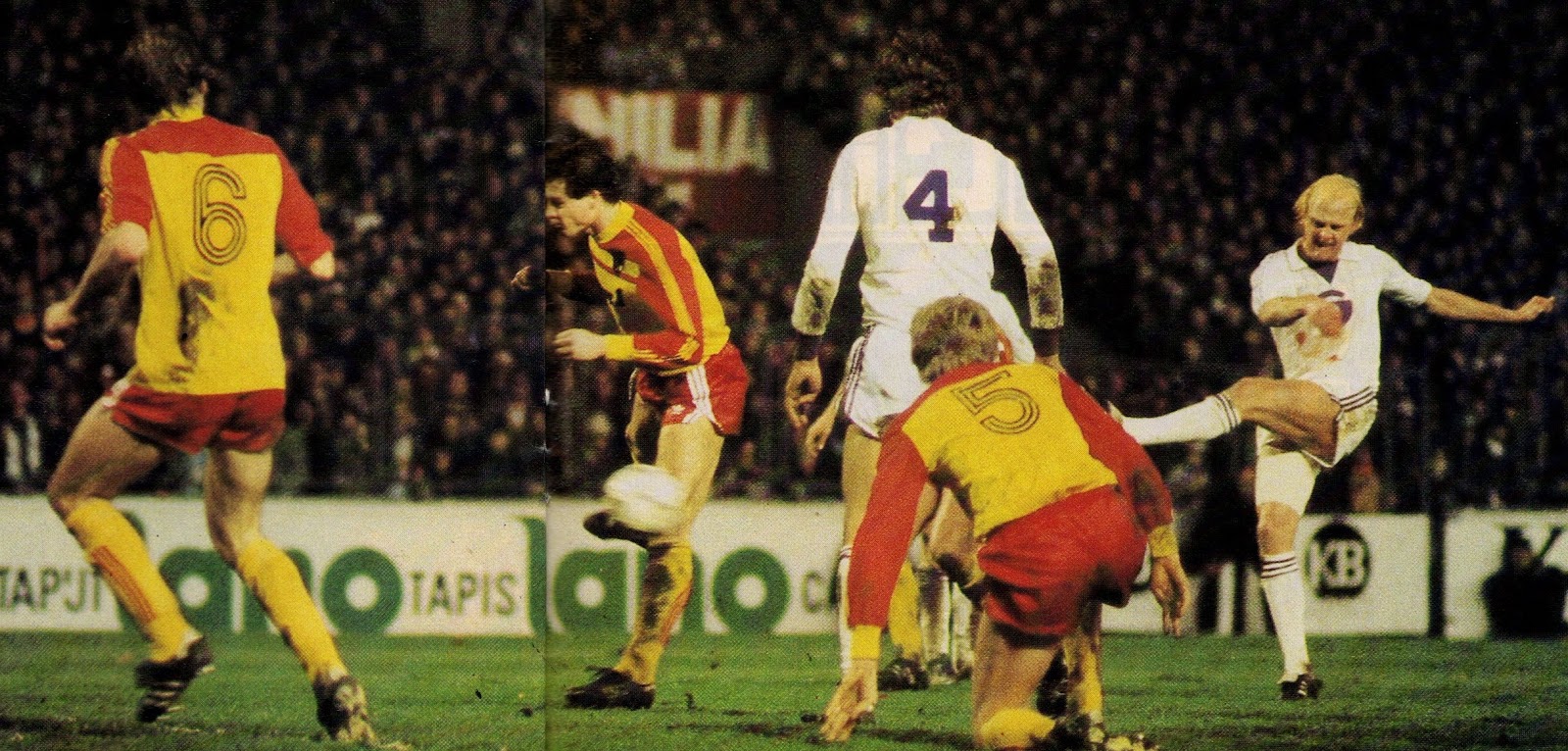
Lens playing at home, employing a 4-3-3 formation  took the initiative. Roman Ogaza had been carrying an injury, as a result Pascal Peltier started as central striker flanked by wingers: Francois Brisson and Daniel Xuereb.
Despite their positive intentions, Lens were unable to break through and finish their moves, as Anderlecht were a more organized and experienced squad.
With the match seemingly headed for a scoreless draw, Anderlecht snatched a goal with two minutes to go.

Photo From: France Football, Issue 1964, November 29, 1983
(Rene vandereycken and Jean-Pierre Tempet)

Frankie Vercauteren from the center of the field released De Groote on the left side who sent a low pass into the box for vandenbergh to score.
At this point, the match seemed to have been decided, however, an incident changed the course of the tie.


Photo From: Onze, Issue 96, December 1983
(Erwin vandenbergh’s goal)

Photo From: Onze, Issue 96, December 1983
(Frankie Vercauteren celebrating Anderlecht’s opener with Tempet on the ground)


Photo From: Mondial, new series, issue 45, December 1983
(Pascal Peltier and Walter De Greef)


In injury time after Anderlecht had cleared a Lens attack, Kenneth Brylle sent a backpass to his goalkeeper Munaron to keep possession. Morten Olsen allowed the ball to pass through his legs for Munaron to pick up.


Photo From: France Football, Issue 1964, November 29, 1983
(Phillipe Vercruysse and Walter De Greef)

Photo From: Mondial, new series, issue 54,September 1984
(Phillipe Vercruysse and Walter De Greef)

What seemed like a routine play suddenly turned into an own goal . Munaron tried to control and pick up the ball with his foot and suddenly the ball rolled into the net.

Photo From: Mondial, new series, issue 45, December 1983
(Jacques Munaron with the rock that was thrown from the stands)


Photo From: Mondial, new series, issue 46, January 1984
(Jacques Munaron with Morten Olsen showing the rock that was thrown from the stands)

At first it was not apparent what had occurred, it seemed like Munaron had made an error and the Television replays were also not very clear at first. However, with clearer analysis, it was clear that as soon as the ball entered the net, Munaron picked up an object (which turned out to be a rock) and tried to show it to the referee.


Photo From: Onze, Issue 96, December 1983
(Trouble in the stands at the conclusion of the match)

Photo From: France Football, Issue 1964, November 29, 1983
(Jacques Munaron leaving the field with beer cans and the rock)

Munaron and the Anderlecht players tried to appeal to the referee that the rock had changed the trajectory of the ball. But it was to no avail as the referee validated the goal, since himself and the linesman had not seen anything.
In any case, according to the laws of the game any and all foreign objects had to be removed from the field for play to continue, so the goal should have been called off.
As he was leaving the field, Munaron carried the rock in question as well as beer cans thrown on the field.

Photo From: France Football, Issue 1964, November 29, 1983
(A cartoon showing Jacques Munaron with areference to the rock thrown)

He was so angry that when French TV reporter Phillipe Houy tried to interview him as he was leaving , he refused his request and just walked off.
After the match there was crowd trouble and police and security forces had to intervene.
Houllier considered his team’s play better and was hopeful for the return leg. He said they have to attack in Brussels, as it was the only solution.
Despite the fluke goal, a draw seemed like a fair result.


November 24, 1983
Racing Club de Lens (France) 1-Royal Sporting Club Anderlecht (Belgium)  1
UEFA Cup- Third Round, First Leg
Venue: Lens - Stade Félix-Bollaert
Attendance: 34,374
Referee: David Syme (Scotland)
Goalscorers: (Lens): Jacques Munaron (own goal) 90th
 (Anderlecht): Erwin vandenbergh 88th

Lineups:
Lens:
1-Jean-Pierre Tempet, 2-Herve Flak, 3-Jean-Pierre Bade, 4-Didier Senac, 5-Francis Gillot, 6-Daniel Krawczyk, 7-Daniel Xuereb (13-Miroslav Tlokinski (Poland) 74th ), 8-Phillipe Piette, 9-Pascal Peltier (12-Roman Ogaza (Poland) 65th), 10-Phillipe Vercruysse, 11-Francois Brisson

Coach: Gerard Houllier

Other Subs:
14-Michel Catalano
15-Alain Tirloit
16-Gaetan Huard

Team Captain: Phillipe Piette
Official Kit Supplier/Designer: Adidas
Shirt Sponsor:  Europe 1
Uniform Colors: Yellow Shirts (Red Sleeves), Red Shorts, Yellow Socks


Anderlecht:
1-Jacques Munaron, 8-Wim Hofkens (Holland) , 2-Luka Peruzovic (Yugoslavia), 10-Morten Olsen (Denmark), 5-Michel De Groote, 11-Kenneth Brylle (Denmark), 3-Walter De Greef, 7-Rene vandereycken, 6-Frank Vercauteren, 9-Erwin vandenbergh , 4-Alex Czerniatisnki (14-Frank Arnesen (Denmark) 85th )

Coach: Paul van Himst

Other Subs:
12-Dirk Vekeman
13-Enzo Scifo
15-Dirk Goossens
16-Georges Grun

Team Captain: Frank Vercauteren
Official Kit Supplier/Designer: Adidas
Shirt Sponsor: Generale Bank
Uniform Colors: White Shirts, White Shorts, White Socks


The second leg, on December 7th , was played at Brussels’ Parc Astrid.
For Lens, Rene Marsiglia started in place of Jean-Pierre Bade, otherwise the squad was unchanged. Pascal Peltier once again deputized for Roman Ogaza.
Anderlecht started with the same lineup.
The day before the match it had been announced that Anderlecht’s Walter De Greef would miss the match. However, on the day of the match he was declared fit. This led Houllier to remark that here it’s like in France, players are injured before and after matches but on the day of match by miracle they are ok to play.
Anderlecht showed its strength and dominated the proceedings and only one outcome seemed certain.

Photo From: France Football, Issue 1966 , December 13, 1983
(Daniel Xuereb saving on the goal lien from a vandenbergh effort)

In the 22nd minute, Daniel Xuereb saved on the goal-line from a Czerniatinski attempt. Initially it seemed like the ball may have passed the line, but no goal was given.

Photo From: France Football, Issue 1966 , December 13, 1983
(Francois Brisson and Walter De Greef)

After many chances Anderlcht broke the deadlock in the 38th minute. Rene vandereycken from the center sends a ball to the left side for Vercauteren who takes a shot. The ball is parried by Tempet and then Vercauteren attempts an overhead kick with the deflected ball. The loose ball is laid on by Czerniatinski to De Greef who takes a shot to the roof of the net.

Photo From: Onze, Issue 97, January 1984
(Walter De Greef scoring the winner)

In the second half, De Greef came close again with a header that hit the post.

Photo From: Onze, Issue 97, January 1984
(Tenpet and Walter De Greef)

Anderlecht were awarded a penalty kick in the 63rd minute when Hofkens was fouled in the box. A foul that injured Hofkens and forced him off. Frankie Vercauteren’s attempt was saved by Tempet.

Photo From: France Football, Issue 1966 , December 13, 1983
(Frankie Vercauteren attempting his pot kick that was saved)

Photo From: Onze, Issue 97, January 1984
(Anderlecht players celebrating the goal)

Anderlecht deservedly won the match by the slimmest margin and qualified for the quarterfinals.
Houllier named De Greef as the Anderlecht’s best player and said with him out, Lens would have won.
He went on to blame the French calendar for his side’s elimination. He mentioned that French teams had already played 21 League matches up to that point, while Belgians were fresher with only 15 matches played.
Lens’ sponsor ‘Europe 1’ gave each Lens player a VCR as a gift.

Anderlecht went on and qualified for the Final of the UEFA Cup, but were defeated by Tottenham Hotspur in the Final.
Lens’ Senac, Xuereb and Brisson had a more memorable end of season as they were instrumental in France winning the 1984 Olympic Title in the Los Angeles Olympics.


December 7, 1983
Royal Sporting Club Anderlecht (Belgium)  1-Racing Club de Lens (France) 0
UEFA Cup- Third Round, Second Leg
Venue: Brussels-Parc Astrid
Attendance: 38,000
Referee: Siegfried Kirschen (East Germany)
Goalscorers: (Anderlecht): Walter De Greef  38th
(Lens): None
Lineups:
Anderlecht:
1-Jacques Munaron, 8-Wim Hofkens (Holland) (16-Georges Grun 64th), 2-Luka Peruzovic (Yugoslavia), 10-Morten Olsen (Denmark), 5-Michel De Groote, 11-Kenneth Brylle (Denmark), 3-Walter De Greef, 7-Rene vandereycken, 6-Frank Vercauteren, 9-Erwin vandenbergh (14-Frank Arnesen (Denmark) 73rd), 4-Alex Czerniatisnki

Coach: Paul van Himst

Team Captain: Frank Vercauteren
Official Kit Supplier/Designer: Adidas
Shirt Sponsor: Generale Bank
Uniform Colors: White Shirts, White Shorts, White Socks

Lens:
1-Jean-Pierre Tempet, 2-Herve Flak, 4-Didier Senac, 5-Francis Gillot, 3-Rene Marsiglia, 8-Phillipe Piette, 6-Daniel Krawczyk, 7-Daniel Xuereb (13-Miroslav Tlokinski (Poland) 73rd), 9-Pascal Peltier (12-Roman Ogaza (Poland) 58th ), 10-Phillipe Vercruysse, 11-Francois Brisson

Coach: Gerard Houllier
Booked: Didier Senac 70

Team Captain: Phillipe Piette
Official Kit Supplier/Designer: Adidas
Shirt Sponsor:  Europe 1

Uniform Colors: Yellow Shirts (Red Sleeves), Red Shorts, Yellow Socks

Thursday, October 9, 2014

The First Time ….., Part Seven

1-The First time that an individual played, as well as managed his national team for over 100 times was Denmark’s Morten Olsen.

Photo From: World Soccer, January 1991
(Morten Olsen)


2- The First Time that a pair of brothers ever played for Scotland was when Moses McLay McNiel and Henry McNiel played on March 25, 1876 at Glasgow vs. Wales (4 to 0 Scotland win).


3- The First Time that the French national team players exchanged jerseys after a match was after a Friendly vs. England at Paris on May 14, 1931 (5 to 2 France win).

Photo From: L'Integrale de L'Equipe de France de Football, Authors: J.M. and Pierre Cazal, Michel Oreggia, 1998
(France squad, Top, left to right: Augustin Chantrel (substitute), Jacques Caudron (Technical Commission), Alexis Thepot, Marcel Capelle, Pierre Hornus, Joseph Kaucsar, Louis Finot, Emile Scharwath (substitute), Etienne Mattler, Pansonetti (physio), Couderat (physio), Gaston Barreau (technical commission), Bottom, left to right: Ernest Liberati, Edmond Delfour, Robert Mercier, Lucien Laurent, Marcel Langiller , May 14, 1931, France 5-England 2)

4- The First Time that the England National team were offered bonuses was for a friendly vs. Germany at Berlin on May 14, 1938 (6 to 3 England win).
FA Secretary and future FIFA President Sir Stanley Rous offered the players a case of cutlery each.

Photo From: World Soccer, June 1974
(Sir Stanley Rous)


Photo From: Kicker Sportsmagazin Edition, 100 Jahre Deutsche Landerspiele
(Ernest Lehner and Edris Hapgood, May 14, 1938, Germany 3-England 6)


5- The First Time that a match by the Italian National team was broadcast on radio was for a Dr. Gerö Cup match vs. Hungary at Rome on March 25, 1928 (4 to 3 Italy win).

Photo From: Guerin Sportivo, April 11-18, 1989
(Italy squad, Top, left to right: Virgilio Levratto, Umberto Caligaris, Silvio Pietroboni,  Fulvio Bernardini, Attilio Ferraris IV, Virginio Rosetta,  Leopoldo Conti,  Gino Rossetti, Giovanni De Prà, Bottom, left to right: Pilotta (a pilot??),  Julio Libonatti, March 25, 1938, Dr. Gerö Cup , Italy 4-Hungary 3)
Note: Adolfo Baloncieri who also played is not visible in the photo

Thursday, April 17, 2014

Memorable European Confrontations, Part 16-1984 Real Madrid vs. Anderlecht

Real Madrid and Anderlecht were paired in the Third Round of the 1984/85 UEFA Cup.
The Spanish Real Madrid, managed by Amaro Amancio, boasted such Spanish stars like Camacho, Gallego, Santillana, as well as foreign stars such as West Germany’s Uli Stielieke, and new Argentine signing Jorge Valdano.
More importantly a new group of youngsters from the Castilla nursery soon to be known as ‘El Quinta del Buitre’ were now part of the first team.
These included Emilio Butragueno (‘El Buitre’), as well as Michel , Sanchis and Rafael Martin Vazquez.
They had qualified with some difficulty from their opening two Rounds. While SSW Innsbruck was eliminated with ease, the Yugoslavians of Rijeka had been a tougher test, and after losing (1-3) away, Madrid had overcome the deficit at home (3-0).
They were lagging behind in the League to Barcelona and in general were having one of their worst domestic seasons in nearly a decade.

On the other hand, The Belgians of Anderlecht, winners in 1983 and finalists the previous season of this competition were riding high domestically and in Europe.
They were still unbeaten in League play and were well on their way to reclaim their League crown last won in 1981.
The Manager was former star Paul van Himst, who would go on to manage the National team.
The team was spearheaded by led by skipper Frank Vercauteren and new 18-year-old star Enzo Scifo.
The Belgian contingent included Internationals such as Erwin vandenbergh, Rene vandereycken, Alex Czerniatinski and George Grun.
The foreigners on their books were Danish stars such as Morten Olsen and Frank Arnesen and Yugoslav defender Luka Peruzovic.
They had been impressive in the competition up to that point; having eliminated West Germany’s Werder Bremen and had hammered Italy’s Fiorentina (1-1 away and 6-2 at home).

The first leg, on November 28th, was played in Brussels’ Parc Astrid Stadium.
Anderlecht were in more confident mood and Real Madrid played their usual poor away game.
Anderlecht were missing the experienced midfielder Rene vandereycken, otherwise were in full strength.
Amancio had deprived his team of the attacking talents of the experienced Juanito (suspended by Real Madrid themselves) as well as former Anderlecht star Juan Lozano.
Frimann’s entry in the second half enabled Vercauteren to have more control of the match and within minutes the goals came.

Photo From: France Football, Issue 2017, December 4, 1984
(Michel, Camacho and Alex Czerniatisnki)

After constant pressure, Anderlecht finally scored in the 66th minute by vandenbergh and the floodgates were opened.  Per Frimann after a one-two with Scifo at the center sent vandenbergh through and he beat Miguel Angel with a low shot.
Just two minutes after a quick counter attack, the ball reached Vercauteren on the left side side touchline who sent in a cross in the goalmouth for Alex Czerniatisnki to head home.
Czerniatinski was immediately booked for over celebration.

Photo From: France Football, Issue 2017, December 4, 1984
(Anderlecht’s Enzo Scifo)

Frank Vercauteren rounded out the scoring in the 85th minute from the spot after a penalty kick was awarded when Chendo brought down Alex Czerniatisnki.

Photo From: France Football, Issue 2017, December 4, 1984
(Anderlecht’s Erwin vandenbergh)

Vercauteren, whose father had passed away a few days before the match, became the Belgian record holder of European matches by playing his 59th match surpassing his current Manager van Himst.

Photo From: France Football, Issue 2017, December 4, 1984
(Per Frimann with Sanchis and Gallego looking on)

Given the general shape of the shape and the respective teams’ domestic form, the tie at this point seemed like a foregone conclusion.

Photo From: France Football, Issue 2017, December 4, 1984
(Real Madrid’s Uli Stielieke)


November 28, 1984
Royal Sporting Club Anderlecht (Belgium) 3- Real Madrid Club de Fútbol (Spain) 0
UEFA Cup- Third Round, First Leg
Venue: Brussels-Parc Astrid
Attendance: 41,000
Referee: Volker Roth (West Germany)
Goalscorers: (Anderlecht): Erwin vandenbergh 66, Alex Czerniatisnki 68-Frank Vercauteren 85pen
 (Real Madrid): None
Lineups:
Anderlecht:
1-Jacques Munaron, 3-Georges Grun, 10-Morten Olsen (Denmark), 2-Luka Peruzovic (Yugoslavia), 5-Michel De Groote, 7-Frank Arnesen (Denmark) (15-Per Frimann (Denmark) 59th), 4-Enzo Scifo, 8-Wim Hofkens (Holland) (14-Walter De Greef 78th), 6-Frank Vercauteren, 9-Erwin vandenbergh, 11-Alex Czerniatisnki

Coach: Paul van Himst
Booked: Alex Czerniatisnki 68th

Team Captain: Frank Vercauteren
Official Kit Supplier/Designer: Adidas
Shirt Sponsor: Generale Bank
Uniform Colors: White Shirts, White Shorts, White Socks

Real Madrid:
1-Miguel Angel, 2-Miguel Chendo, 5-Fraile, 4-Uli Stielieke (West Germany), 3-Jose Antonio Camacho, 10-Michel, 6-Ricardo Gallego, 7-Manuel Sanchis, 8-Rafael Martin Vazquez (14-San Jose 46th), 11-Jorge Valdano (Argentina) (16-Emilio Butragueno 75th), 9-Carlos Santillana

Coach: Amaro Amancio
Booked: Miguel Chendo 27th, Fraile 54th, Michel 89th

Team Captain: Carlos Santillana
Official Kit Supplier/Designer:  Adidas
Shirt Sponsor:  Zanussi
Uniform Colors: Purple Shirts, Purple Shorts, Purple Socks


The second leg, on December 7th, was played at Madrid’s Estadio Santiago Bernabeu.
Real Madrid started with former Anderlecht star Juan Lozano and Emilio Butragueno starting upfront, with San Jose replacing Chendo in defense.


Anderlecht sacrificed one striker (vandenbergh) to bring in an extra midfielder (Per Frimann) and had only Czerniatisnki upfront and still missing Rene vandereycken.
Anderlecht believed they had all but qualified and their overconfidence was their undoing as Real Madrid achieved one of its most European comebacks that it would become known for in the coming years.


Real Madrid scored their six goals in the first 50 minutes as they attacked relentlessly and without mercy.
Enzo Scifo admitted afterwards that they had it so easy in the League and in Europe from the beginning of the season that they believed they just needed to show up to qualify.
An anonymous Real Madrid player later said that the Spaniards had expected to meet a team that would defend every portion of the field instead they met a team that behaved like sheep.


Morten Olsen later remarked that they should have marked Juan Lozano out of the game instead they allowed him total freedom.
Real opened the scoring in the third minute when a free kick from the right by Lozano from the left was headed in by Sanchis.


For the second goal in the 16th minute, Emilio Butragueno headed in a cross from Valdano from the right side.
For the third goal in the 29th minute, Gallego sent Emilio Butragueno clear on the right side who immediately passed across for Valdano to stab home in an empty net.
Anderlecht pulled a goal back in the 34th minute, when Frimann scored after a scramble in the goalmouth.


For Real’s fourth goal in the 39th minute was similar to their third goal, with Gallego sending Butragueno clear on the right and he crossed for Valdano to score.
For Real’s fifth in the 47th minute, Camacho crossed from the left that was pushed back by the Anderlecht defense into the path of Butragueno who scored.
For the final goal in the 50th minute, a cross from the left reached Butragueno who after a scramble scored.


Real Madrid qualified and went on to win the UEFA Cup in May by defeating Hungary’s Videoton.
Anderlecht did go on and win their League title.

December 7, 1984
Real Madrid Club de Fútbol (Spain) 6-Royal Sporting Club Anderlecht (Belgium) 1
UEFA Cup- Third Round, Second Leg
Venue: Madrid-Estadio Santiago Bernabeu
Attendance: 85,000
Referee: Michel Vautrot (France)
Goalscorers: (Real Madrid): Manuel Sanchis 3, Emilio Butragueno 16,47,50, Jorge Valdano 29, 39
  (Anderlecht): Per Frimann 34

Lineups:
Real Madrid:
1-Miguel Angel, 5-San Jose, 4-Uli Stielieke (West Germany), 3-Jose Antonio Camacho, 2-Michel (14-Jose Salguero 55th), 6-Ricardo Gallego, 7-Manuel Sanchis, 10-Juan Lozano (15-Rafael Martin Vazquez 73rd), 11-Jorge Valdano (Argentina), 8-Emilio Butragueno, 9-Carlos Santillana

Coach: Amaro Amancio
Booked: Michel 5th, Juan Lozano 7th

Team Captain: Carlos Santillana
Official Kit Supplier/Designer:  Adidas
Shirt Sponsor:  Zanussi
Uniform Colors: White Shirts, White Shorts, White Socks


Anderlecht:
1-Jacques Munaron, 3-Georges Grun, 10-Morten Olsen (Denmark), 2-Luka Peruzovic (Yugoslavia), 5-Michel De Groote (15-Arnor Gudjohnsen 53rd), 8-Wim Hofkens (Holland) (13-Henrik Andersen (Denmark) 83rd), 9-Frank Arnesen (Denmark), 7-Per Frimann (Denmark) , 4-Enzo Scifo, 6-Frank Vercauteren, 11-Alex Czerniatisnki

Coach: Paul van Himst
Booked: Alex Czerniatisnki 68th

Team Captain: Frank Vercauteren
Official Kit Supplier/Designer: Adidas
Shirt Sponsor: Generale Bank

Uniform Colors: Purple Shirts, Purple Shorts, Purple Socks