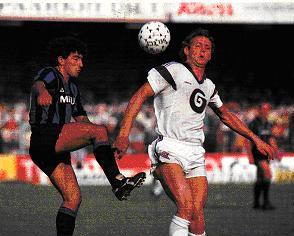
1- The Internazionale management had wanted to replace German defender Andreas Brehme with German midfielder Mathias Sammer in the summer of 1991.
However, Brehme’s German compatriots Lothar Matthaus and Jurgen Klinnsman insisted that Brehme should remain at the club.
The Inter Management backed down and Sammer stayed one more season with Stuttgart. He eventually joined Inter the following summer, while Matthaus, Brehme and Klinnsman all left.
Photo from: World Soccer, October 1991
(Mathias Sammer and Kevin Ratcliffe, June 5, 1991, UEFA Euro Qualifier, Wales 1-Germany 0)
Photo From: Mondial, October 1988
(Internazionale’s West German players Andreas Brehme and Lothar Matthaus with goalkeeper Walter Zenga)
Photo From: Fussball Magazin, December 1989
(Jurgen Klinnsman in action for Inter vs. Cremonese, 1989/90 season)
2- Jean-Claude Pagal, who played for Cameroon during the 1990 World Cup, punched Frenchman Henri Michel, the National Team Manager, at Paris’ Orly Airport after he had been dropped from the National Team for the 1994 World Cup.
Photo From: Mondial, October 1984
(France national Team Manager Henri Michel on the cover of Mondial)
3- During the 1991/92 season, Bayern Munich were going through an injury crisis with their goalkeepers as first choice Raimond Aumann and understudy Sven Scheuer were both injured.
Therefore Bayern was left with one recognized goalkeeper in thiord choice Gerald Hillringhaus.
As a result former West German goalkeeper Harald Schumacher was persuaded to come out of retirement to help as a goalkeeper and played 8 matches in total.
He later became goalkeeping coach for Borussia Dortmund and actually played one final match on the last day of 1995/96 season with the Bundesliga title already clinched.
Photo From: Onze-Mondial, February 1992
(Harald Schumacher with Bayern kit)
Photo From: World Soccer, December 1991
(Gerald Hillringhaus and Harald Schumacher)
4- Dutch striker Dennis Bergkamp was known for his flying phobia.
The origin of his condition started during the 1994 World Cup in USA.
During a flight one of the plane’s engines cut out, this led to a journalist joking about having a bomb in his bag.
As a result he would travel to away matches either by car or train.
For some matches he did not travel at all, due to the distance and time issues.
Photo From: France Football, June 30, 1992, Issue 2412
(Henrik Larsen and Denni Bergkamp, June 22, 1992, European Championships-Denmark 2-Holland 2)
5- For very first World Cup Final on July 30th, 1930 betweeen Argentina and Uruguay, each team wanted to play the final with its own ball.
The Belgian referee Johannes (John) Langenus made a compromise whereby each half would be played with one of the balls. Argentine team would provide the ball for the first half and the Uruguayans would provide their own for the second.
11-Preben Elkjaer-Larsen (Koninklijke Sporting Club Lokeren / Belgium)[34 / 21]
Coach: Josef "Sepp" Piontek (West Germany)
Team Captain: Allan Rodenkam Simonsen, Jens Jorn Bertelesen (Second Half)
Official Kit Supplier/Designer: Hummel
Uniform Colors: White Shirts, Red Shorts , White Socks
Photo From: Foot Magazine, No. 34, April 1984
(Denmark squad, Top, left to right: Madsen, Sivebaek, Molby, Brylle, Laudrup, Kjaer, bottom, left to right: Simonsen, Lauridsen, Elkjer, Nielsen, Bertelsen)
Notes:
-Match number 417 for Holland and number 462 for Denmark.
-This was the 22nd meeting between the nations.
-The previous match between the nations, as well Denmark’s previous win, was a EC Qualifier, played on October 4, 1967, that Denmark won 3 to 2.
Michael Laudrup’s father Finn played in that match as well as Johan Cruijff.
That season (1983/84) Cruijff was playing his last season as a professional with Feyenoord and was teammates with Denmark’s Ivan Nielsen and Holland’s Gullit, Wijnestekers, Hoekstra, Houtman and Hiele.
-The previous match between the nations, as well Holland’s previous win, was a EC Qualifier, played on November 30, 1966 at Rotterdam’s De Kuip Stadium, that Holland won 2 to 0.
-The previous match between the nations in the same city was a Friendly played on March 13, 1955, that ended in a one to one tie. The match was played at Amsterdam’s Olimpisch Stadion.
-The next match between the nations as well the next one on Dutch soil, would be a Friendly also played in Amsterdam, in Olympisch Stadion, on September 6, 1989 that ended in a 2 to 2 tie.
Holland players: Hiele, Koeman, and Kieft and Denmark Players: Sivebaek, Ivan Nielsen, Michael Laudrup and Frimann also took part in that match.
Michael Laudrup’s younger brother Brian also played in that match, while Sepp Piontek was still the Denmark manager.
Ronal Koeman who was a non-playing substitute for this 1984 match scored on a penalty kick for Holland.
Photo From: Foot Magazine, No. 34, April 1984
(Michael Laudrup)
-Denmark’s next win over Holland was a UEFA European Championship Finals match, played in Göteborg, Swedenon June 22, 1992, that actually ended in a 2 to tie, but Denmark won a penalty kick shoot-out 5 to 4.
Holland players: van Tiggelen, Koeman, Kieft, Rijkaard and Gullit and Denmark Player John Sivebaek also took part in that match.
Michael Laudrup’s younger brother Brian also played in that match
Frank Rijkaard scored one of Holland’s goals.
Denmark’s next actual win in a full-length match was during the recent UEFA European Championship Finals on June 9, 2012 in Kharkiv, Ukraine that Denmark won 1 to 0.
-Holland’s next win over Denmark was a UEFA European Championship Finals match, played in Rotterdamon June 16, 2000, that Holland 3 to 0.
Frank Rijkaard managed Holland in that match.
-West German Sepp Piontek had managed Denmark since 1979. Piontek also managed the Haiti national team in 1977 and also became Turkey Manager in 1990.
- Holland was awarded their penalty kick after Hokstra was fouled in the box.
Peter Houtman had no sleep the night before as his wife gave birth to a son.
Photo From: Foot Magazine, No. 34, April 1984
(John Lauridsen)
-Denmark was using this friendly as preparation for the upcoming UEFA European Championships in France.
Denmark had qualified from a group containing England, Hungary, Greece and Luxembourg.
-Holland having failed to qualify used this a preparation for the upcoming World Cup qualifiers in the fall.
This turned out to be their only match in the spring, needless to say, had they qualified, they would have played more friendly matches.
Holland was still in shock after Spain’s 12-1 win over Malta on December 21, 1983 had overtaken them at the top of the group on goal difference.
Holland’s group won by Spain also contained Republic of Ireland, Iceland and Malta
-Holland only played four matches the entire calendar year, this match and three World Cup qualifiers at the end of the year.
Photo From: Foot Magazine, No. 34, April 1984
(Ole Madsen and Rene van der Gijp)
-Denmark had many key players missing.
Bayern Munich’s Soren Lerby and Gent’s Soren Busk opted out because their clubs had cup matches on that day.
Captain Morten Olsen of Anderlecht was out sick.
Ajax’s Jesper Olsen, Pisa’s Klaus Berggren and Anderlecht’s Frank Arnesen were all injured.
The absent Bergrren was teammates at Pisa with Holland’s Kieft.
-Denmark Manager Sepp Piontek blamed the heavy defeat on missing 5 starters
-Denmark’s Ole Madsen played only once more for Denmark, the next friendly vs. Spain on April 11, 1984.
Photo From: Foot Magazine, No. 34, April 1984
(Bertelsen and Hoekstra)
-Denmark’s Allan Hansen earned his next and final cap on January 27, 1985 in a 0 to 1 friendly loss to Honduras.
-On December 1984, Preben Elkjaer-Larsen was voted as Denmark’s player of the year.
-This was, Dutch goalkeeper, Pieter ‘Piet’ Schrijvers’ last match for Holland. After this Hans van Breukelen was the number one Holland goalkeeper until 1992.
For this match, Pieter ‘Piet’ Schrijvers was the only remaining player from 1970s glory era for Holland.
Though by fall, Ernie Brandts and Willy van der Kerkhof would play for Holland.
-Dutch manager Kees Rijvers only managed Holland for one more match. His last match was the World Cup qualifier vs. Hungary on October 17, 1984 that resulted in a 2 to 1 home loss.
He resigned as Holland manager by November and Rinus Michels was appointed as Holland manager.
Rijvers played for Feyenoord (like many of the players on either team) and also French club AS Saint Etienne (like Denmark’s Sivebaek).
He also managed PSV Eindhoven, like non-playing substitute Ronald Koeman.
-This was Dutchman Andre Hoekstra’s one and only cap for Holland and he scored one goal.
Photo From: Sport Illustrierte, Fussball Sport, Fussball 1984 Sonderheft
(Ole Madsen and van Tiggelen)
-Holland made no substitutions during the match.
-The match was played in Ajax’s home stadium of De Meer and they were four players from both sides who were playing in their home stadium.
-Holland were missing Ajax’s Marco van Basten, Gerald Vanenburg and Pete Boeve, as well as Groningen’s Erwin Koeman, Ronald’s brother.
Groningen’s Bud Brocken appeared to be out of national team reckoning.
With Michel Valke and Willy van der Kerkhof missing, there were no PSV players in the Dutch lineup, which was a rare occurrence.
-This was Denmark’s worst defeat since losing to Romania 1 to 6 in an EC Qualifier in Bucharest on March 11, 1975.
-Denmark’s Jan Molby was an Ajax player and was teammates with Holland’s Ophof, Silooy, Rijkaard and Koeman.
Denmark’s absent midfielder Jesper Olsen was also an Ajax player.
Denmark’s absent defender Morten Olsen managed Ajax in the 1990s and is the current Denmark National team manager.
Denmark’s absent midfielders Soren Lerby and Frank Arnesen were also former Ajax players.
Wim Kieft, Vanenburg, Ronald Koeman, Arenesen and Lerby were past Ajax players and future PSV Eindhoven players.
Denmark’s Ivan Nielsen also eventually joined PSV in 1986 and was teammates with the above-mentioned players.
Holland’s Rene van der Gijp joined PSV Eindhoven as well the following season, as did Denmark’s Kenneth Brylle.
Michael Laudrup and his younger brother Brian also eventually played for Ajax Amsterdam.
Holland’s Adri van Tiggelen was another future PSV player.
-Denmark’s Ole Kjær,John Sivebak, Ole Madsen and Allan Simonsen were the only home based players, all the rest were on foreign teams.
All Holland players played in Holland except van der Gijp and Kieft.
-Holland’s van der Gijp and Denmark’s Elkjaer were teammates at Belgian club Lokeren.
-Ruud Gullit, Frank Rijkaard, Adri van Tiggelen, Wim Kieft, Joop Hiele and Ronald Koeman were members of the victorious Dutch squad that won the 1988 UEFA European Championships.
-Denmark’s John Sivebaek was a member of squad that won the 1992 edition. That Denmark squad also included Michael Laudrup’s younger brother Brian as well as Jan Molby’s cousin.
-Holland’s Adri van Tiggelen eventually joined Belgium’s Anderlecht where he was teammates with Denmark’s Per Frimann.
-Denmark became the surprise team of the 1984 UEFA European Championships and reached the semi finals.
This team also qualified for the 1986 World Cup for the first time.
The term ‘Danish Dynamite’ was coined for this generation that played an attacking attractive game.
-After his successful performances in the Euros, Preben Elkjaer transferred to Italy’s Verona and won the scudetto in 1985.
-Holland’s Kieft and Koeman and Denmark’s Nielsen were teammates on the PSV Eindhoven team that won the 1988 Champions Cup.
-Holland’s Koeman and Denmark’s Laudrup were teammates at Barcelona under manager Johann Cruijff.
They won the Champions Cup together in 1992.
Both also managed in Spain with Valencia and Getafe respectively. Laudrup is the current manager of Swansea in the EPL, while Koeman manages Feyenoord.
Allan Simonsen is a former Barcelona player.
-Holland’s Gullit and Rijkaard also won the Champions Cup with AC Milan in 1989 and 1990.
-Rijkaard also won it with Ajax in 1995. Sonny Silooy was also part of that Ajax squad though he did not play.
Rijkaard also managed the Dutch national team (1998-2000) and has also managed Barcelona to the Champions League triumph in 2006.
-Denmark’s Jens Jorn Bertelesen assumed captaincy in the Second Half, after Simonsen was substituted.
-Denmark’s Allan Simonsen was captain as Morten Olsen was unavailable.
Simonsen broke his leg in a collision with France’s Yvon Le Roux in the first match of the Euros on June 12, 1984 (France won 1-0) and had a lengthy injury recovery.
-Denmark’s Michael Laudrup was playing for Serie A’s Lazio on loan from Juventus. He had turned down Liverpool to join Juventus.
-Denmark’s Simonsen and Holland’s Gullit won the Ballon d’Or in 1977 and 1987 respectively.
-This was Denmark goalkeeper Ole Kjaer’s last cap. His poor performance ended his national team career. After this Troels Rasmussen and Ole Qvist disputed the number one position with Qvist getting the job for the Euros.
Holland’s Gullit, Rijkaard and Kieft and Denmark’s Sivebaek, Laudrup and Elkjaer all played in Italy’s Serie A in their career.
All except Sivebaek won Serie A scudettos in their career.
Holland’s Gullit and Denmark’s Sivebaek, Molby and Simonsen all played in the English League in their career.
Molby won League titles with Liverpool.
Holland’s Silooy and Kieft and Denmark’s Sivebaek, Bertelesen and Brylle all played in the French League in their career.
Holland’s Silooy and Denmark’s Hansen, Simonsen and Elkjaer all played in the West German Bundesliga in their career.
Holland’s van Tiggelen, van der Gijp and Houtman and Denmark’s Frimann, Brylle and Elkjaer all played in the Belgian League in their career.
Holland’s Koeman and Rijkaard and Denmark’s Lauridsen, Simonsen and Laudrup all played in the Spanish League in their career.
-Denmark’s John Sivebaek as well Denmark’s absent duo of Lerby and Busk all played for France’s AS Monaco in their career.
-Denmark’s Brylle and Holland’s Houtman both played for Belgium’s Club Brugge in their career.