The
1989/90 season was anticipated, as it would lead up to the World Cup that the
Italians would be hosting on home soil the following summer. The Nation was
mobilized to have all the Stadia and facilities ready in time for the main
event in less than a year.
But
as was the case like the previous off-season, it was Diego Maradona’s off the
field drama that caught all the headlines.
Due
to the Copa America Tournament over that summer, as well as, the CONMEBOLWorld
Cup Qualifiers, most South America players were expected to arrive after the
start of the season.
 |
Photo
From: Calcio 2000, Issue 22 Supplement, August-September 1999
(Diego Maradona with Napoli fans) |
As
defending World Cup Champions, Argentina had no such worries, however, it was
Maradona himself who delayed his return. It would turn out that the ambitious
French Club Olympique Marseille of Bernard Tapie had convinced Maradona to join
them. The player himself was more than willing, as the pressure of the Serie A
seemed to be getting to him after five years and the less pressured atmosphere
of the French League appealed to him.
It
was also believed he was threatened by Napoli’s crime syndicate, The Camorra.
Needless
to say, Napoli and its President Corrado Ferlaino were unwilling to give up on
their most prized asset. This soap opera continued for over a month, but
getting back to the other teams.
 |
Photo
From: Calcio 2000, Issue 22 Supplement, August-September 1999
(Diego
Maradona with Corrado Ferlaino)
|
The
defending Champions Internazionale Milano of Giovanni Trapattoni, already more
than satisfied with the West German duo of Lothar Matthaus and Andreas Brehme,
added a third. Jurgen Klinnsman arrived from Stuttgart to replace the
Argentinean veteran Ramon Diaz, who went to France’s AS Monaco.
 |
Photo
From: Fussball Magazin, December 1989
(Jurgen Klinsman) |
The
European Champions AC Milan of Arrigo Sacchi had maintained their Dutch trio.
All three (Ruud Gullit, Marco van Basten and Frank Rijkaard) missed the start
of the season through various injuries. While van Basten and Rijkaard would
shortly be back, Gullit would miss virtually the entire season. In fact
Gullit’s physical state would be one of the ongoing sagas of the season, as he
was originally expected to miss weeks, then it became months and months.
The
veteran striker Pietro Paolo Virdis had left to join Lecce, but Daniele Massaro
had returned from his one season loan at Roma. Young Como striker Marco Simone
had been acquired and Stefano Borgonovo had come back from his loan at
Fiorentina (where he had formed a lethal partnership with Roberto Baggio the
previous season).
Future
International midfielder Diego Fuser had arrived from relegated Torino.
Other
new arrivals included goalkeeper Andrea Pazzagli (Ascoli), Stefano Carobbi and
Stefano Salvatori (both Fiorentina) and Giovanni Stroppa (Monza).
The
once mighty Juventus managed by Dino Zoff, it seemed were no longer the kings
of the transfer market and it showed in their selections. Denmark’s Michael
Laudrup had left to join Barcelona. Veteran defender Antonio Cabrini had been
offloaded to Bologna. Other departures included Alessandro Altobelli, Luciano
Favero, Marino Magrin, Massimo Mauro and Renato Buso.
They
had wanted to offload the disappointing Soviet star Alexander Zavarov, but
apparently there were no takers, so they chose to persevere him for one more
season. They acquired another Soviet midfielder, Sergei Aleinikov of Dinamo
Minsk (after it looked he was set to join Genoa) to perhaps help Zavarov as
well. Portuguese midfielder Rui Barros remained as their third foreigner. The attempted
triple signing from Sampdoria of Gianluca Vialli, Roberto Mancini and Pietro
Vierchowod always seemed to be wishful thinking.
 |
Photo
From: Onze-Mondial, Issue 16, May 1990
(Juventus’ Sergei Aleinikov) |
More
telling was their failure to lure Denmark’s Fleming Povlsen (Koln) and the
Brazilian pair of Carlos Dunga (Fiorentina) and Luis Muller (Torino) despite
serious attempts.
Italian
defender Dario Bonetti and midfielder Daniele Fortunato had arrived from Verona
and Atalanta respectively. Angelo Alessio returned from his one season loan at
Bologna. The surprise additions were two strikers from Serie B, Pierluigi
Casiraghi (Monza) and Salvatore Schillaci (Messina).
Ottavio
Bianchi had left his post as Napoli Manager at the end of the previous seasons,
after many rows with players including Maradona. The new man in charge was the
former Cesena Manager Albertino Bigon. The Brazilian pair Careca and Alemao had
remained. The main arrivals were Massimo Mauro from Juventus, Marco Baroni from
Lecce and a young unknown midfielder from Torres named Gianfranco Zola.
 |
Photo
From: Calcio 2000, Issue 22 Supplement, August-September 1999
(Napoli Manager Albertino Bigon) |
Sampdoria
of Gianluca Vialli welcomed Yugoslavia’s Srecko Katanec and Attilio Lombardo
from Cremonese. Otherwise, Yugoslav Manager Vujadin Boskov had retained the
same bloc of players.
 |
Photo
From: Onze-Mondial, Issue 16, May 1990
(Sampdoria’s new recruit Attilio Lombardo) |
West
German defender Thomas Berthold left Verona to join his compatriot Rudi Voeller
at AS Roma (with new Coach Gigi Radice in charge).
Argentinean
striker Claudio Caniggia left Verona to join Atalanta, who had offloaded
Swedish midfielder Robert Prytz.
Newly
promoted Udinese registered the Argentinean pair of Nestor Sensini and Abel
Balbo who would go on and shine in Italy for more than a decade for various
teams.
Spanish
midfielder Ricardo Gallego also joined Udinese after over a decade of service
at Real Madrid.
Veteran
Italian striker Bruno Giordano joined Luigi Maifredi’s ambitious Bologna side,
as did Bulgaria’s Nikolai Iliev and Brazil’s Geovani (one of Brazil’s flops at
the Copa America).
Newly
promoted Genoa under the well-respected Manager Francesco Scoglio acquired the
Uruguayan trio of Carlos Aguilera, Ruben Paz and Jose Perdomo.
Though
perhaps overlooked at the time, Marcello Lippi was given his first managerial
position in the Serie A with Cesena.
Fiorentina
acquired Czechoslovakia’s Lubos Kubik and Argentina’s Oscar Dertycia, as well
Juventus’ Renato Buso. Due to ongoing construction on their home stadium for
the upcoming World Cup, they would play all their home matches away in Pistoia
and Perugia. This disadvantage would hamper their season, despite their
progress in the UEFA Cup.
The
season started on August 27th, as expected without Maradona.
He
had been expected to be back by August, but he delayed his return for a month.
He finally returned and everything was seemingly back to normal. Nevertheless,
Napoli had no choice but to open a Civil Lawsuit against him because of his
unprofessional behavior.
The
second matchday on September 3rd saw AC Milan unexpectedly lose at
home to Lazio, with a bizarre own goal from Paolo Maldini. He lobbed his own
goalkeeper from long range, while attempting a backpass. Napoli were already
leaders, as they were the only team to have won its opening two matches.
Salvatore Schillaci also displayed his potential with two goals in a (4-1)
Juventus win over Verona. However, that day was tragic for Italian Football as
a whole. Former Juventus Libero Gaetano Scirea was killed in an automobile
accident near a Village called Babsk in Poland. Scirea, who was on Dino Zoff’s
staff, was in a supervising mission for Juventus on their Polish opponents
Gornik Zabrze for the upcoming First Round of the UEFA Cup.
In
the following week (Matchday 3, September 10), Inter suffered its first loss of
the season at Sampdoria (0-2), Juventus’ win over Ascoli, as well as Napoli’s
away win at Verona, made the two joint leaders.
However,
by the following week (Matchday 4, September 17), Juventus’ limitations would
be exposed as they lost at Inter (1-2).
Napoli
took over the sole lead with a (3-2) win over Fiorentina, after having fallen
behind 0-2. Maradona made his first appearance of the season after coming on as
a substitute.
Fiorentina’s
Roberto Baggio scored one of his most famous goals, after he took the ball in
his own half and dribbled past many defenders to score (very reminiscent of
Maradona’s goal vs. England in 1986).
Three
days later, ‘Baggiomania’ would take over Italy, with his two-goal performance
for the National team vs. Bulgaria in a friendly.
On
Matchday 6 (September 24), Maradona would score his first goal in an away tie
with Cremonese that would help them to hold on as League leaders.
The
following week (Matchday 7, October 1), would feature the league leaders Napoli
of Maradona taking on the struggling AC Milan. The more in form Napoli side
convincingly defeated Milan (3-0) to be favorites for the title.
One
of the most enduring images of Maradona for years to come would be him wearing
Franco Baresi’s exchanged jersey after the match.
On
the same day, Inter recovered somewhat by defeating Roma (3-0) to move up to
second place.
On
the following week, AC Milan (with van Basten making his first appearance)
continued its poor form by losing at Cremonese, while Juevntus also lost ground
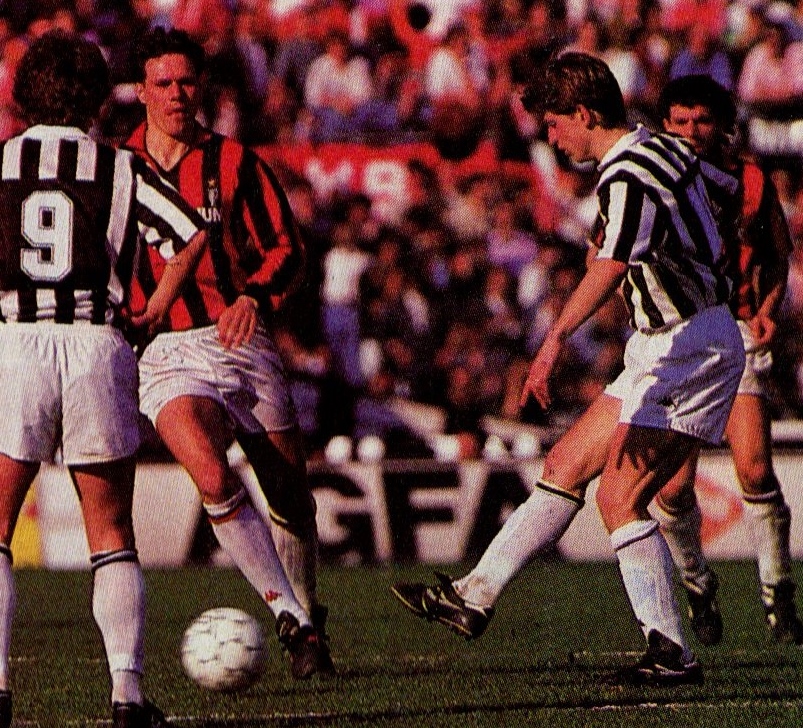
by losing at home to Atalanta.
 |
Photo
From: Onze-Mondial, Issue 16, May 1990
(Marco van Basten and Giancarlo Marocchi, March
11, 1990, Juventus 3-AC Milan 0) |
On
Matchday 9 (October 22), the next table-topping clash would pit Napoli at home
vs. the German inspired defending Champions of Inter. Once again Napoli would
come out winners with goals from Maradona and Careca to consolidate its lead.
On the same day, Marco van Basten would score his first goal of the season as
Milan defeated Roma (1-0).
Diego
Maradona had an eventful few days prior to his wedding in November.
Napoli
were scheduled to play Wettingen in the UEFA Cup in midweek, Maradona skipped
training and rested at home for two days.
When he showed up on the third day, Corrado Ferlaino had had enough and
sent him home.
Then
on November 2nd, Maradona allegedly punched a fifteen year old after
a training session, which led to a Police Complaint.
On
Matchday 11 (November 5), van Basten would signal AC Milan’s recovery and once
again Juventus’ shortcomings by scoring twice in a (3-2) win. The League
leaders Napoli would hold onto the top position by defeating Lecce (3-2).
Following
the match, Maradona would fly off to Buenos Aires to marry Claudia Villafane.
The
following Round (Matchday 12, November 19), AC Milan would defeat its neighbors
Inter (3-0) with van Basten once again amongst the goalscorers.
The
important clash on the following week (Matchday 13, November 26) would see the
leaders Napoli hold onto a tie at Juventus (1-1).
The
still injured Ruud Gullit had yet another operation by famed Belgian Surgeon
Marc Martens on November 29th and it was clear his layoff would be
long term. In total he would have three operations in less than a year.
In
the next round (Matchday 14, December 3), Napoli would defeat Atalanta (3-1)
with the young playmaker Gianfranco Zola (wearing the number 10 jersey, as
Maradona was rested and only came on as a substitute) scoring one of the goals
with a beautiful curling shot.
In
the meantime, the Draw for the upcoming World Cup finals was made, Maradona
once again stirred controversy by declaring the draw had been fixed to favor
Italy at the expense of Argentina. As a result, the Italian Federation demanded
disciplinary action against Maradona. (He would be fined in January)
Napoli
would suffer its first League defeat of the season in the last round of the
first phase of the season (Matchday 17, December 30), when they lost at Lazio
(0-3). Inter’s win at Udinese placed
them in second place just two points behind Napoli. (25 points vs. 23 points).
On
that day, tragedy was averted after AS Roma’s Lionella Manfredonia collapsed in
the 5th minute of their match at Bologna. He was revived and rushed
to a hospital, but stayed in a coma for a couple of days.
The
second half of the season would see the resurgence of AC Milan, with Marco van
Basten in excellent form. He was
awarded his second Ballon d’Or in December ahead of clubmates Franco Baresi and
Frank Rijkaard.
Milan
also clinched the UEFA Super Cup (vs. Barcelona) and the Intercontinental Cup
(vs. Atletico Nacional Medellin) in December.
The
prolonged absence of Ruud Gullit was compensated with more than adequate
response from the rest of the squad.
Milan were so impressive that at one point, AC Milan President Silvio
Berlusconi suggested Azeglio Vicini, the National Team Manager, should select
the entire AC Milan’s Italian contingent in place of the current struggling
players.
National
Team Manager Azeglio Vicini responded that a Manager should take decisions
objectively and that Milan’s best players were in fact its Dutch duo (van
Basten and Rijkaard).
On
Matchday 19 (January 14), AC Milan won away at Lazio (3-1) and Napoli drew at
Udinese (2-2). This tightened the race at the top. Napoli had 28 points, while
Inter (27 points) and AC Milan (26 points) were right behind.
The
next day Maradona was again at the center of another controversy. Giuseppe
Pacileo of ‘Il Mattino’ had given Maradona a note of 3.5/10 for his performance
vs. Udinese. The two men came face to face at a Naples studio where Maradona
was doing his weekly TV show. He threatened Pacileo that he would make him eat
his own newspaper.
AC
Milan and Napoli continued winning for the next few rounds, with van Basten
scoring in phenomenal fashion.
 |
Photo
From: Onze-Mondial, Issue 16, May 1990
(Juventus’ Roberto Galia and Fiorentina’s
Roberto Baggio, January 17, 1990, Fiorentina 2-Juventus 2) |
His
excellent form was rewarded with a new improved contract until 1993 (with an
option for an extra year) that was announced on January 23rd. Van
Basten would sign it on February 9th.
Despite
the revelation of Schillaci, Juventus had been declining for many years now.
Gianni Agnelli felt a change of direction was needed. He announced that Dino
Zoff would leave his post at the end of the season.
Around
this time, former Juventus great Michel Platini accused long serving
Administrator Giampiero Boniperti of having squandered Agnelli’s money on
ineffective transfers. Boniperti announced his departure after these attacks.
In
any case, it was believed that Boniperti and Agnelli had not seen eye to eye on
many transfers. Boniperti had wanted Andreas Moeller, while Agnelli had been
opposed. It was Agnelli who had insisted on Zavarov’s signature, while
Boniperti had been doubtful.
On
February 5th, Boniperti announced his resignation.
As
for Zavarov, himself and his old Manager Valeri Lobanovsky placed the blame of
his failure on Dino Zoff. They both
blamed Zoff for positioning him on the left side instead of his preferred
central position.
On
Matchday 24 (February 11), Napoli and Milan would meet in the most anticipated
clash of the season. In contrast to the first encounter, AC Milan were now the
more in form squad. They completely
dominated Napoli at home and won (3-0) with goals by Daniele Massaro, Paolo
Maldini and van Basten. The teams were now level on points (36 each).
Just
three days later, Milan once again showed its dominance over Napoli by
defeating them at San Paolo, in the second Leg of the Coppa Italia Semifinals
(3-1) to qualify for the Final after a goalless first Leg.
On
Matchday 26 (February 25), AC Milan would break free and lead for the first
time in the season. Napoli would lose again, this time vs. Inter (1-3), while
Milan would defeat Roma away (4-0). AC
Milan now had 40 points and Napoli had 38.
At
this point, Milan seemed odds on favorites to win the title. But it was
precisely around this time, in the beginning of spring, that their implosion
started.
On
Matchday 28 (March 11), they were defeated at Juventus (0-3). Napoli could only
draw at Lecce but nevertheless reduced the deficit to one point.
 |
Photo
From: Onze-Mondial, Issue 16, May 1990
(Luigi De Agostini and Angelo Colombo, March 11,
1990, Juventus 3-AC Milan 0) |
The
following week (Matchday 29, March 18), Milan were defeated once again, this
time by neighbors Inter (1-3). Though Napoli themselves were also defeated at
Sampdoria (1-2).
On
Matchay 30 (March 25), both teams won, but Maradona’s two-goal display vs.
Juventus signaled his return to form.
Physiotherapist
Antonio Dal Monte was credited for placing Maradona on a special diet. He lost
significant weight and was sharper and fitter in the final weeks of the season.
A
few days later, Juventus’ Salvatore Schillaci’s fine form (in addition, to the National Team’s
struggles to score goals regularly) earned him his Azzurri debut in a friendly
vs. Switzerland on March 31 (1-0 Italy win).
 |
Photo
From: Onze-Mondial, Issue 17, June 1990
(Salvatore
Schillaci)
|
The
following week (Matchday 31, April 8) would be significant in deciding the
final outcome. AC Milan could only manage a scoreless draw at Bologna. Napoli
managed the same at Atalanta. However, an object from the stands hit Napoli’s
Alemao. As a result the score was overturned as (2-0 win for Napoli, ‘a
tavolino’) by the League. This made the teams level on points with three
matches to go.
Both
teams won their next match and each had 47 points heading into the penultimate
round (Matchday 33, April 22).
Both
teams were away, AC Milan at Verona and Napoli were at Bologna.
AC
Milan went ahead through Simone and seemed set to win. Arrigo Sacchi decided to
send on Ruud Gullit for his very first appearance of the season. Unfortunately,
for Milan, Verona fought back and tied up the score. The Milan players’ nerves
gave way and Arrigo Sacchi, Rijkaard, van Basten and eventually Alessandro
Costacurta were all sent off. Milan
were completely demoralized and Verona scored a winner through Davide
Pellegrini, virtually handing over the title to Napoli, who were winning at
Bologna (4-2). Napoli were now ahead by two points (49 vs. 47) going into the
last match, and their victory seemed certain if not yet mathematical.
A
few days later, Milan would also lose the Second Leg of the Coppa Italia Final
to Juventus to miss out on domestic honors.
The
last Round (Matchday 34, April 29) saw Napoli defeat Lazio with a Marco Baroni
goal and Napoli were champions for the second time in four seasons.
 |
Photo
From: Calcio 2000, Issue 22 Supplement, August-September 1999
(Maradona and Alemao celebrating) |
Marco
van Basten was top goalscorer with 19 goals, with Baggio just behind with 17,
Maradona with 16 and the revelation of the season Salvatore Schillaci with 15.
A
few weeks later AC Milan triumphed in the Champions Cup (1-0 vs. Benfica) to
salvage their end of the season.
In
fact Italian teams all triumphed in Europe, Sampdoria won the Cup Winners Cup
and Juventus won the UEFA Cup in an all-Italian affair vs. Fiorentina.
The
Italian dominance in the European Cups allowed as much as eight Italian teams
to be represented in Europe for the following season. (Napoli and AC Milan in
C1, Sampdoria and Juventus in C2, Roma, Inter, Bologna and Atalanta in C3)
Verona
who had been champions just five years earlier were relegated, along with Udinese,
Cremonese and Ascoli.
The
significant departures at the end of the season included the already mentioned
Dino Zoff, who was appointed as the new Manager of Lazio, as well as, AC Milan
goalkeeper Giovanni Galli joining Napoli, while Napoli forward Andrea
Carnevalle would go on to join AS Roma after four successful seasons and two
Scudetti.
 |
Photo
From: Calcio 2000, Issue 22 Supplement, August-September 1999
(Napoli’s Andrea Carnevalle) |
Inter’s
Alessandro Mateolli would join the newly promoted Cagliari of Claudio Ranieri.
The
most significant transfer that was finalized just weeks after the end of the
season and before the World Cup was that of Roberto Baggio. Juevntus paid a
World Record fee of £ 7.7 Million to acquire the
excellent player.
This
led to riots and unrest by the Fiorentina fans, which in turn led to the
downfall of Count Flavio Pontello’s reign as Fiorentina owner.
Not
to mention, the disruption of the National team’s World Cup preparation at
nearby Coverciano.
The
World Cup was a disappointment as Italy finished third, but Schillaci and
Baggio had been the toast of Italy.
Of
course the World Cup ended in tears (literally) for Maradona as well. Maradona
was about the enter his last and most difficult season in Italy (1990/91
season, to be continued…..)
 |
Photo
From: (Magazine Source unknown) / Contribution From a blog viewer
(Napoli squad 1989/90, Top, left to right: Andrea Carnevalle, Ricardo Alemao, Raffaele Di
Fusco, Giulliano Giuliani, Giovanni
Francini, Giancarlo Corradini, Middle, left to right: Tebaldo Bigliardi,
Massimo Tarantino, Massimo Mauro, Albertino Bigon, Diego Maradona, Massimo
Crippa, Ciro Ferrara, Bottom,
left to right: Alessandro
Renica, Fernando De Napoli, Antonio Careca, Maurizio Neri, Gianfranco Zola,
Luca Fusi, Marco Baroni) |