Monday, April 23, 2012

Trivia and Facts-Part 16

1-Holland’s Dirk Nanninga pulled out of an International call-up for a match vs. West Germany on December 20, 1978 (won 3-1 by W. Germany), because of pressure of Christmas work in his wife’s flower shop.

Photo from : France Football, May 23, 1978, Numero 1676
(Dirk nanninga before a Friendly match with Holland vs. Paris St. Germain)


2- West Germany played a European Championship qualifier in Stutgart vs. Bulgaria on November 19, 1975 that they won 1-0.
Real Madrid pair of Gunther Netzer and Paul Breitner were omitted from this match.
They jointly declared that they would never play for West Germany again due to their omission from this match.
West German Manager Helmut Schoen claimed he had received a letter from Real Madrid informing him that Breitner was injured, as a result he decided not to call up either one.
Eventually Breitner was made a comeback six years later in 1981 for Schoen’s successor Juup Derwall.


(Real Madrid squad photo from 1974/75, Standing from left to right: Camacho, Benito, Miguel Angel, Del Bosque, Rubinan, Breitner, Seating, from left to right, Aguilar, Santillana, Roberto Martinez, Netzer, Velazquez)


3- When Ronaldo arrived at Internazionale FC Milano in the summer of 1997, his personalized jersey number was not the customary number 9, it was number 10.
The number 9 jersey belonged to Chilean striker Ivan Zamorano from the previous season.
The following season with new kit sponsors Nike (also Ronaldo’s) on board, the number 9 jersey was made available to Ronaldo.
However, Zamorano had the idea of having the number 18 jersey and intead adding a small ‘+’ sign between the 1 and 8, so that 1+8=9.
Photo from:Onze-Mondial, January 2000
(Ivan Zamorano and Alessandro Nesta, June 11, 1998, World Cup, Italy 2-Chile 2)

Photo from : Calcio 2000, February 2001
(Ronaldo with the 1997 Ballon d’Or trophy as an Inter player)


4- During the 1986/87 season, Internazionale FC Milano’s Argentinean defender, Daniel Passarella, struck a ball boy during a league match.
Inter were losing the match and Passarella felt the boy was deliberately wasting time in giving him the ball for a throw-in.
He later apologized to the boy and his father.

Photo from: Onze, November 1982
(Daniel Passarella, June 29, 1982, World Cup, Italy 2-Argentina 1)


5- During the Mundialito tournament in Uruguay (January 1981), one night West German players : Karl-Heinz Rummenigge, Manfred Kaltz, Hansi Muller and Hans-Peter Briegel left the team hotel to go out on the town and broke curfew.
They were discovered and reprimanded by Manager Juup Derwall the following day.
It was also alleged by Hotel sources that in between the two matches, the German players went through 1200 bottles of beer.


Photo from: Onze, Hors Serie 12
(West German squad, January 1, 1981, Mundialito, Argentina 2-West Germany 1)

Sunday, April 22, 2012

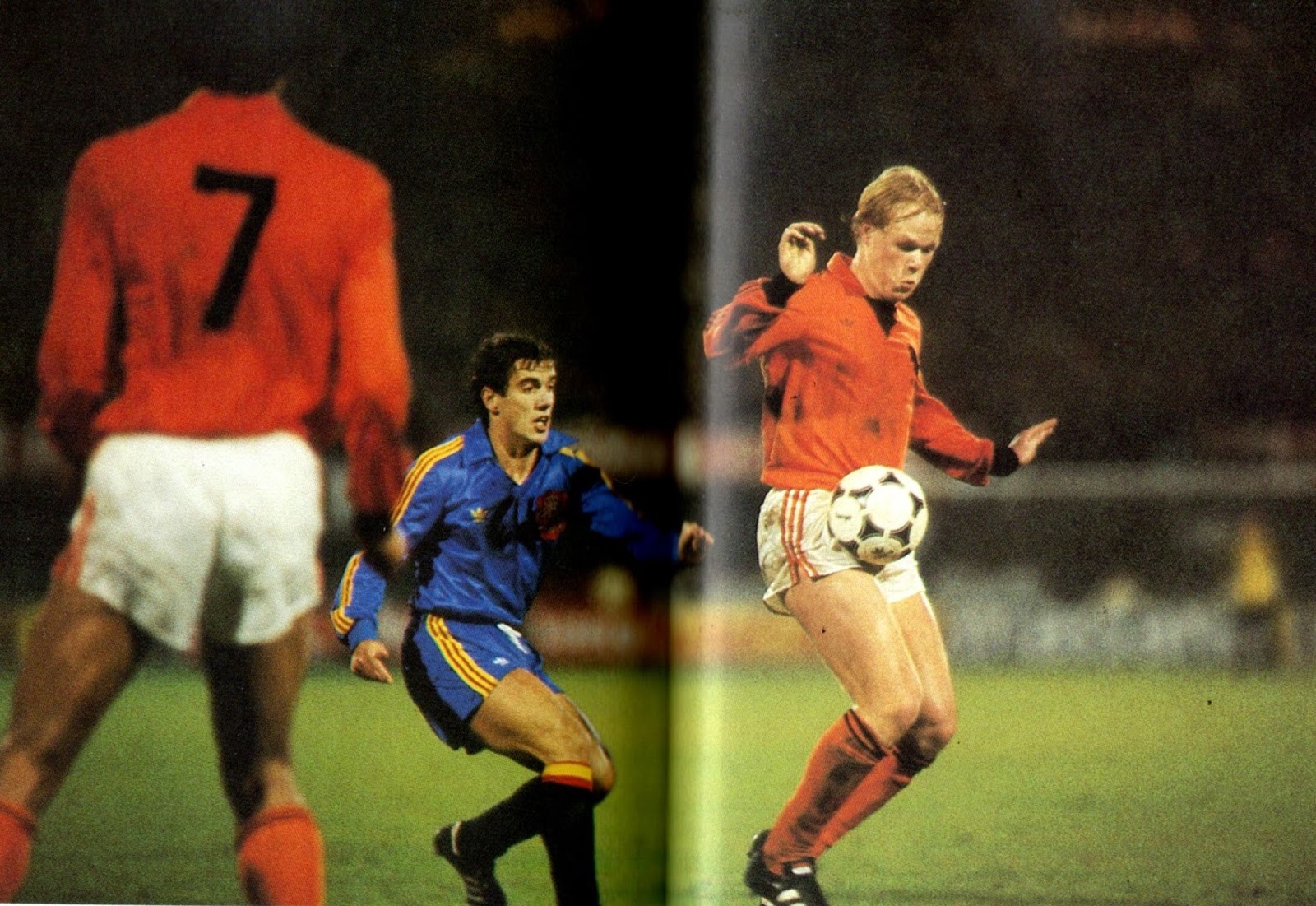
November 16, 1983 -Holland 2-Spain 1

November 16, 1983
Holland 2-Spain 1
UEFA European Championship Qualifying-Group 7     
Venue: Rotterdam-De Kuip-Feyenoord Stadion       
Attendance: 58,000
Referee: Michel Vautrot (France)
Goalscorers: (Holland): Peter Houtman 26, Ruud Gullit 63     
 (Spain): Carlos ‘Santillana’ 41
Lineups:
Holland:
1-Pieter ‘Piet’ Schrijvers (PEC (Prins Hendrik E.D.N.( Ende Desespereert Nimmer) Combinatie) ’82-Zwolle) [44 / 0]       
5-Huibertus Johannes Nicolaas ‘Ben’ Wijnstekers (Feyenoord Rotterdam) [26/ 0]
7-Rudi Dil ‘Ruud’ Gullit (Feyenoord Rotterdam) [11/ 5]  
3-Edo Ophof (Amsterdamse Football Club Ajax-Amsterdam) [11 / 2]  
4-Peter Boeve (Amsterdamse Football Club Ajax-Amsterdam) [10 / 0 ] 
8-Wilhelmus Antonius ‘Willy’ van de Kerkhof  (Philips Sports Vereniging Eindhoven) [54/ 5] 
6-Ronald Koeman (Amsterdamse Football Club Ajax-Amsterdam) [5 / 1]
10-Gerald Mervin Vanenburg (Amsterdamse Football Club Ajax-Amsterdam) [8/ 0]
2-Erwin Koeman (Football Club Groningen) [3 / 0] 
11-Budde Jan Peter Maria ‘Bud’ Brocken (Football Club Groningen) [4 / 0] 
9-Petrus Johannes ‘Peter’ Houtman  (Feyenoord Rotterdam) [3 / 2] 

Coach: Cornelius ‘Kees’ Rijvers
Booked: Wilhelmus Antonius ‘Willy’ van de Kerkhof  75

Other Subs:
Johannes Frederik ‘Joop’ Hiele (Feyenoord Rotterdam)
Jan Jacobus ‘Sonny’ Silooy (Amsterdamse Football Club Ajax-Amsterdam) 
Adrianus Andreas ‘Adri’ van Tiggelen (Football Club Groningen)
Machiel ‘Michel’ Valke  (Philips Sports Vereniging Eindhoven)
Hubertus ‘Huub’ Jozef Margaretha Stevens (Philips Sports Vereniging Eindhoven)  

Team Captain: Huibertus Johannes Nicolaas ‘Ben’ Wijnstekers
Official Kit Supplier/Designer: Adidas
Uniform Colors: Orange Shirts, White Shorts, Orange Socks

Photo From: Het Nederlands Elftal, De Histoire van Oranje, 1905-1989


Spain:
1-Luis Maria ‘Arconada’ Echarri (Real Sociedad de Fútbol) [52 / 0]  
2-Jose Vicente ‘Sánchez’ Felip (Fútbol Club Barcelona) [13 / 0]  
4-Antonio ‘Maceda’ Frances (Real Sporting de Gijón) [11 / 2]  
5-Andoni ‘Goikoetxea’ Olaskoaga (Athletic Club de Bilbao) [5 / 0]  
3-Jose Antonio ‘Camacho’ Alfaro (Real Madrid Club de Fútbol)           [42 / 0]  
10-Ricardo ‘Gallego’ Redondo (Real Madrid Club de Fútbol) [9 / 1]  
11-Juan Antonio ‘Senor’ Gomez (Real Zaragoza) [8 / 3]  
6-Rafael ‘Gordillo’ Vazquez (Real Betis Balompié-Sevilla) [42 / 1]  
8-Francisco ‘Guerri’ Ballarin (Real Zaragoza) [2 / 0]    (16-Hipolito ‘Rincon’ Povedano (Real Betis Balompié -Sevilla) [5 / 1]  67)
9-Carlos ‘Santillana’ Alonso Gonzalez (Real Madrid Club de Fútbol) [41 / 8]    
7-Francisco Javier ‘Carrasco’ Hidalgo (Fútbol Club Barcelona) [14 / 1]   (15-‘Marcos’ Alonso Pena (Fútbol Club Barcelona) [16 / 0]  78)

Coach: ‘Miguel Munoz’ Mozun
Booked: Rincon 72

Other Subs:
Francisco Buyo (Real Zaragoza)
Salvador ‘Salva’ Garcia Puig  (Real Zaragoza)
Enrique ‘Quique Ramos’ Gonzalez (Club Atlético de Madrid)

Team Captain: Luis Maria ‘Arconada’ Echarri

Official Kit Supplier/Designer: Adidas

Uniform Colors: Blue Shirts, Blue Shorts , Black Socks


Notes:

-Match number 415 for Holland and number 279 for Spain.

-This was the 6th meeting between the nations.

-This was a UEFA European Championship Qualifier, The other teams in the group were Republic of Ireland, Iceland and Malta.

-The previous match between the nations, as well as Spain’s previous victory over Holland, was the first leg of this Qualifier, played in Sevilla on February 16, 1983, that Spain won 1-0 from a penalty kick by Juan Senor.
Holland players: Schrijvers,  Wijnstekers, Gullit and Boeve and Spain Players:  Arconada, Maceda, Goikoetxea, Camacho, Senor, Gordillo, Carrasco, Gallego and Marcos also took part in that match.
Dutch player Vanenburg was an un-used substitute for that match, while Valke who was an un-used substitute for the November match did play in the February match.
Spain’s Hipoliuto Rincon was am un-used substitute for that match, while Francisco Buyo was an un-used substitute for both matches.


-The next match between the nations would be a Friendly in Barcelona on January 21, 1987 that ended in a one-one tie.
Holland players: Gullit and Vanenburg and Spain Players:  Goikoetxea, Camacho and Gordillo also took part in that match.
Dutch player Ronald Koeman was un-used substitute for that match, while van Tiggelen and Silooy  who was an un-used substitutes for the 1983 match did play in this 1987 match. Joop Hiele was an un-used substitute for both matches.

-Holland’s previous victory over Spain had been a 3-2 Friendly win in Amsterdam on May 2, 1973.


-Holland’s next win over Spain would be a 2-1 Friendly win in Sevilla on November 15, 2000.

-Spain’s next win over Holland would be the 2010 World Cup Final in South Africa on July 11,  2010 (1-0 win).

-Spain were wearing their away uniform of Blue.

-The dutch were missing the Ajax pair of Marco van Basten and Frank Rijkaard.

-Spain were missing Barcelona’s Victor Munoz.

Photo From: France Football, January 10, 1984, Numero 1970
(Willy van der Kerkhof)


-Less than two months before this match, on September 24, 1983, Andoni Goikoetchea had savagely injured Barcelona’s Diego Maradona.

-Andoni Goikoetchea had made his debut for Spain vs. Holland on February 16th, 1983.

-Holland believed they had more or less qualified after this win, however, Spain in their last match on December 21st vs. Malta controversially won 12-1 and edged out Holland on goal difference. In that match both Santillana and Rincon scored 4 goals apiece.


-Erwin and Ronald Koeman are brothers.

-Ronald Koeman played for FC Barcelona (1989-1995).
He also managed Valencia CF in the Spanish La Liga.

-Gullit, Ronald Koeman and Valke have played for both PSV Eindhoven and Feyenoord in their careers.

Photo From: Het Nederlands Elftal, De Histoire van Oranje, 1905-1989
(Ronald Koeman)


-Jose Antonio Camacho has managed the Spanish national team (1998-2002).

-Wijnstekers, Gullit and Houtman  were playing in their home stadium.

-Holland did not call-up Real Madrid based Johnny Metgod for this match.


-Gullit, Ronald Koeman and Gerald Vanenburg eventually became teamamtes at PSV Eindhoven.

-Erwin Koeman and un-used substitute Adri van Tiggelen also played for PSV Eindhoven in their careers.
Both were rivals in teh Belgian League when playing for Mechelen and Anderlecht respectively.

Photo From: Onze, Issue 96, December 1983


-Ricardo Gallego of Spain and Ruud Gullit of Holland eventually joined Italy’s Serie A by joining Udinese and AC Milan respectively.

-Francisco Carrasco and un-used dutch substitute Sonny Silooy joined the French League later in their careers by joining Sochaux and Matra Racing Paris respectively.

Photo From: Het Nederlands Elftal, De Histoire van Oranje, 1905-1989
(Dutch midfielder Erwin Koeman wearing a Spanish shirt after the match)


-By the following year, Spain changed their kit designer to Le Coq Sportif. They would revert back to Adidas in the Fall of 1991.

-Maceda, Gordillo and Buyo would eventually join Real Madrid. Hipolito Rincon is a former Real Madrid player.


Match Reports:

Todo Sobre La Seleccion Espanola, Felix Martialay, 2006

Het Nederlands Elftal, De Histoire van Oranje, 1905-1989


Match Video / Highlights:


Thursday, April 5, 2012

Soccer Memories: Part Five

Real Madrid’s Miracle Comebacks

(Note: I would like to once again thank http://www.zani.co.uk/ for uploading this article http://www.zani.co.uk/real-madrids-miracle-comebacks )

Real Madrid’s team of the mid to late 80s is often described as its best since the 1950s glory days.
The obvious reason is because of its five consecutive League titles from 1986 through 1990.
However, this team is mostly remembered for its European Cup ties and its specialty of overturning seemingly lost matches in the second or return leg of a series.
The beginnings of this team can be traced back to the 1983/84 season, when then manager and former Legend Alfredo Di Stefano promoted players from the nursery team, Castilla, that eventually were dubbed as “El Quinta del buitre.”
The five players in question were Emilio Butragueno, Michel, Manuel Sanchis, Rafael Martin Vasquez and Miguel Pardeza.
“El Buitre” (The Vulture) was the nickname given to Butragueno, the most hyped and prolific of the five.
These players would form the backbone of Real Madrid’s team for the rest of the successful decade, though Miguel Pardeza left in 1987, frustrated by the lack of first team action.

Photo From: Onze, June 1986
(Emilio Butragueno, the local symbol of Real Madrid)

The European Miracles started the following season of 1984/85.
In November and December of 1984, Real encountered RSC Anderlecht of Belgium in the Third Round of the UEFA Cup. Anderlecht was then a powerful side having won the 1983 edition and been the losing finalist of that competition the previous season. They boasted international players such as Enzo Scifo, Vercauteren, Vandenbergh and a host of Danish stars such as Morten Olsen and Frank Arnesen.
The Belgians convincingly won the first leg 3-0 and the second leg appeared to be a formality.
Besides the result, Real Madrid’s domestic form that season had been erratic and were having one of their poorest season in decades.
Therefore, no one gave them a chance of advancing.
Real against all odds won the return leg 6-1 and demolished one of the best teams in Europe.
Emilio Butragueno, who was now a full international, scored a hat trick and new Argentinean striker Jorge Valdano chipped in with two.
Real advanced on after defeating Tottenham Hotspurs in the Quarterfinals to defeat Italians of Internazionale FC Milano. Once again Real was defeated 0-2 in the first leg against a defensive minded Italian side and once again they defied the odds by winning 3-0 in the return leg.
After that the Final was against Hungary’s Videoton and Real Madrid won comfortably to claim its first European trophy since 1966.
While there was jubilation over this triumph, the league form had left a lot to be desired and they finished a disgraceful (by their standards) fifth place.
By now (1985), Real’s last title had been in 1980, one of its longest droughts between titles.
A new President was elected named Ramon Mendoza and he sought to strengthen the team.
He purchased Spanish Internationals Antonio Maceda and Rafael Gordillo and prolific Mexican goalscorer Hugo Sanchez from neighbors Atletico Madrid.
Long serving West German Uli Stielieke was offloaded along with little used Belgian/Spanish midfielder Juan Lozano.


Photo From: Onze, May 1986
(Rafael Gordillo, a key signing for Real)

The following Season, 1985/86, was simply fantastic as Real Madrid finally won the league title and repeated as UEFA Cup champions by defeating West Germans FC Koln in the Final. By now Michel and Butragueno were established members of the national team and Sanchez scored freely and was once again top goalscorer in the league. A feat he would repeat for a total of 5 times (1985, 1986,1987, 1988, 1990).

Photo From: Onze, June 1986
(Mexican goalscoring machine, Hugo Sanchez)

Once again in the UEFA Cup, Real overcame seemingly lost causes. First in fall of 1985 vs. West Germany’s Borussia Moenchengladbach, it lost the first leg 1-5 and seemed out and again they overcame the deficit in the second leg by winning 4-0 and advancing on away goals rule.
Just like the previous season, they were paired with Italy’s Internazionale in the semifinals and once again they overcame a deficit, this time 1-3 loss in the first leg and 5-1 win in the second leg.


Photo From: Onze, June 1986
(Real Madrid squad on April 30, 1986, UEFA Cup, Real 5-FC Koln 1)


For 1986/87 season, a new manager was introduced, Dutchman Leo Beenhakker but results remained the same.
Once again Real triumphed in the league but reached the semifinals of the Champions Cup. In the Champions Cup they eliminated Platini’s Juventus on penalty kicks after once again winning 1-0 at home but losing by the same score away.
They pulled one of their European specials by eliminating Red Star of Belgrade, they lost 2-4 away but won 2-0 at home and advanced on away goals rule.
The semifinals vs. West Germans Bayern Munich became one obstacle too many. After losing heavily 1-4 away, they bombarded the Bayern goal in the second leg, but could only muster a 1-0 win and were eliminated.
This marked their first elimination in European competition stretching back as far as the fall of 1983.
The Bayern ties were also famous for the ill temper shown by the Real Madrid players.
They had two players sent off in the first leg, plus in the second leg Hugo Sanchez’s play acting earned Bayern’s Klaus Aughentaler a red card.
These behaviors along with crowd trouble forced UEFA to stamp down on Real Madrid. For the following season, they were forced to play the first round in an empty home stadium and the in the second round, they were forced to play in Valencia instead of their home stadium.
Also midway through this season, Argentinean Jorge Valdano had to retire due to Hepatitis and was replaced by Yugoslav midfielder Milan Jankovic.
The next season 1987/88, once again a comfortable league win and once again semifinal elimination in the Champions Cup.
After defeating Diego Maradona’s Napoli in an empty Bernabeu stadium, they defeated defending Champions Portugal’s FC Porto 2-1 at “home” in Valencia.
Real’s very narrow win and Porto’s solid performance had most predicting a Porto win, however, in the second leg at Porto, Real played one its best ever matches in Europe and won 2-1 with two Michel goals.
In the Quarterfinals they met Bayern Munich, but this time they were stronger and advanced.
In the Semi-Finals they met PSV Eindhoven and were unluckily eliminated by the away goals rule (one-one tie at home and scoreless tie away).
For the next season, 1988/89, Barcelona’s West German midfielder Bernd Schuster came on board as Milan Jankovic exited.
Real once again triumphed in the league and also the Copa del Rey but once again fell at the Semi-Final hurdle of the Champions Cup for the third year in a row.
After defeating defending Champions PSV Eindhoven at the Quarterfinals, they were paired with in the Semi-Finals with the AC Milan and its Dutch contingent of Ruud Gullit, Marco van Basten and Frank Rijkaard.
After a one-one tie at Madrid, Real was demolished 0-5 at Milan.
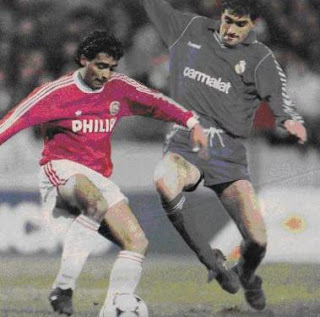
Photo From: France Football, March 7, 1989
(Real’s Michel and PSV’s Romario, March 1, 1989, Champions Cup, PSV Eindhoven 1-Real Madrid 1)

This seemed to be the beginning of the decline of the great Real Madrid. Leo Beenhakker resigned and Welsh Manger John Toshack was appointed.
Despite winning the league title again (5th time) the following season, they were eliminated in the second round of Champions Cup by AC Milan again.
By 1990/91 season, despite the addition of Romanian star Gheorge Hagi, the great team of “El Quinta del buitre” was all but a memory and was in crisis.
The lagged behind in the league to Johann Cruyff’s Barcelona who were to become the new dominant team of the new decade.
Rafael martin Vasquez had departed to the Italian Serie A’s Torino, while Hugo Sanchez was mostly injured and rarely played.
They were no longer a force in Europe and the specialty of overturning deficits was a thing of the past.
By now Butragueno, Michel and the rest seemed to be burnt out and were living on past glories. Even their place in the National team seemed to be based on their past and not present performances.
Hugo Sanchez went on to say that the reason for the slump was due to boredom of having won so many titles.
Club President Ramon Mendoza should be credited for holding on to the players for as long as he did.
He had to give the players Italian Serie A level wages to keep them.
The interesting aspect of this Real Madrid team was how, in the European Competitions, they would almost always lose the away tie even to modest opposition, such as Rijeka (1984), AEK Athens (1985), Young Boys Bern (1986) but were confident with the knowledge that at Bernabeu they would win by a large margin.
Real would not win a league title until 1995 with Jorge Valdano back as manager. By then the local jewel in the crown was Raul.
Butragueno and Martin Vasquez became peripheral figures and left in 1995, Michel left a year later.
Manuel Sanchis would be the sole holdout of this era and would Captain Real until 2001.
In the post Bosman era, Real Madrid would win the Champions League three times in 1998, 2000 and 2002 with global stars such as Luis Figo, Zinedine Zidane, Pedrag Mijatovic and Roberto Carlos.
But no new trophies could replace the memories of repeatedly performing miracles in the European Cups.

Saturday, March 31, 2012

Articles on Teams and Events-Part 10

An article about Scotland’s Willie Johnston’s drugs ban during the 1978 World Cup
(Magazine / Language : Goal, April 1996 / English)


Photo from:  Goal, April 1996
(Scotland’s Willie Johnston)


An article about Iran-Australia World Cup Qualifier from 1977
(Magazine / Language : Onze, September 1977 / French)


Photo from:  Onze, September 1977
(August 14, 1977, World Cup Qualifier, Australia 0-Iran 1)

An article about AS Roma’s title winning season of 1982/83
(Magazine / Language : Calcio 2000, February 2000 / Italian)

AS Roma 1982/83


Photo from:  Calcio 2000, February 2000
(AS Roma squad  1982/83)

Friday, March 30, 2012

Player Profiles-Part 10

A profile on Swiss striker Stephane Chapuisat
(Magazine / Language : World Soccer, March 1992 / English)


Photo from: World Soccer, December 1996
(Stephane Chapuisat, October 9, 1996, World Cup Qualifier, Finland 2-Switzerland 3)


A profile on 1980s Iceland star Asgeir Sigurvinsson
(Magazine / Language : Foot Magazine, January 1982 / French)


Photo from: Foot Magazine, January 1982
(Asgeir Sigurvinsson in action for Bayern Munich)


A profile on Belgian goalkeeper Michel Preud’homme
(Magazine / Language : Voetbal International, February 18, 1989/ Dutch)


Photo from: Voetbal International, February 18, 1989
(Michel Preud’homme)

Thursday, March 29, 2012

Interviews-Part 13

An interview with West German defender Berti Vogts
(Magazine / Language : World Soccer, February 1974 / English)


Photo from : Onze, August 1976
(Berti Vogts, May 22, 1976, EC Quarterfinals, West Germany 2-Spain 0)


An interview with Argentina’s Mario Kempes
(Magazine / Language : Mondial, March 1983 / French)


Photo From: El Grafico, LA Historiade Argentina en Los Mundiales, de Uruguay 30 a Corea-Japon 2002, April 2006
(Mario kemps, June 14, 1978, World Cup, Argentian 2-Poland 0)


An interview with Brazilian Tostão
(Magazine / Language : Don Balon, Chile Edition, April 24, 1997 / Spanish)


Tostão Interview


Photo From: Don Balon, Chile Edition, April 24, 1997
(Tostão in action fro Brazil)